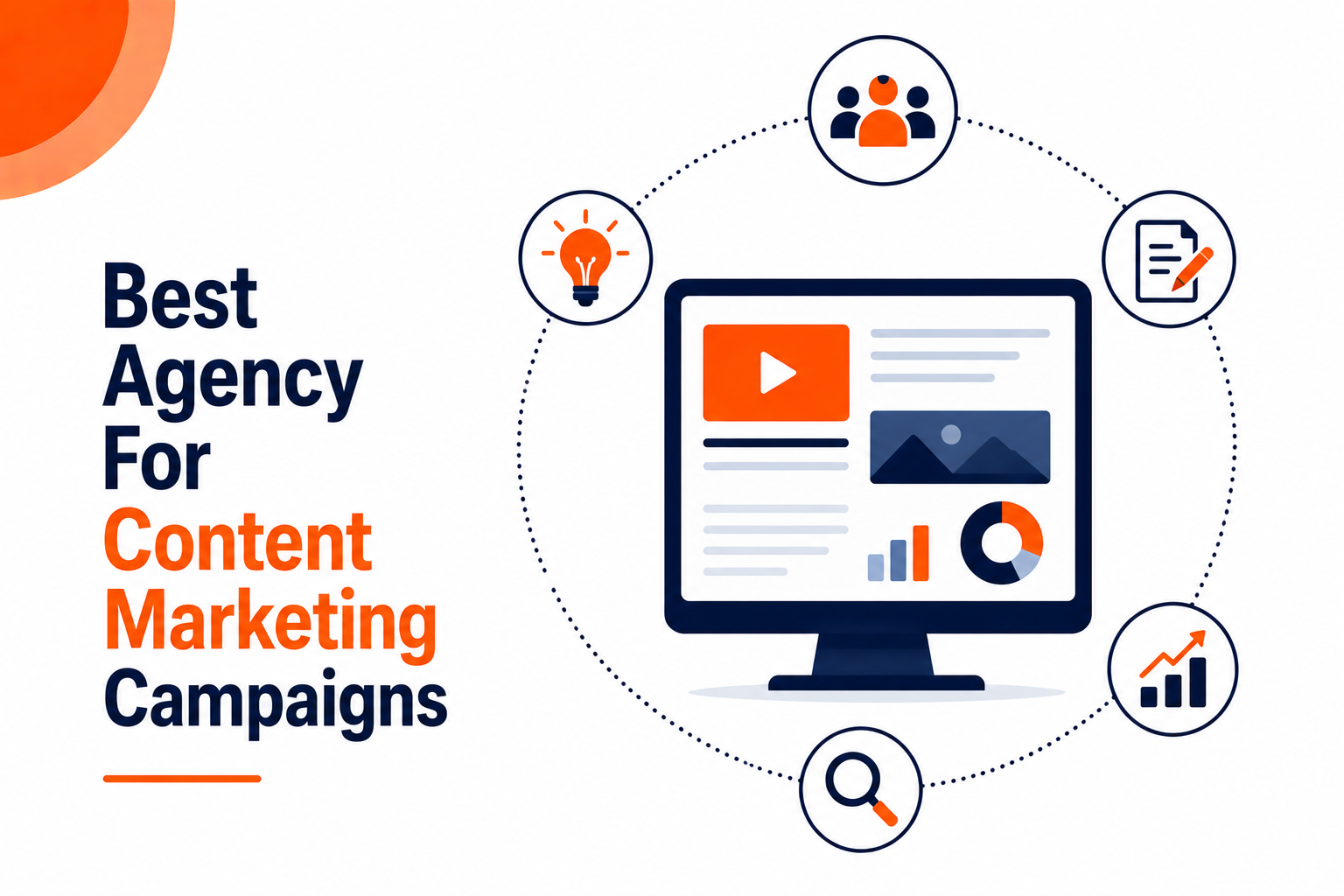
Best Agency For Content Marketing Campaigns
The best agency for content marketing campaigns is the one that can turn content into measurable business results, not just published pages. Most agencies produce blog posts and social updates on a set schedule, but far fewer build campaigns tied to goals like leads, signups, or sales, and even fewer track those goals once the content goes live. The wrong agency choice usually shows up months later, once budget has gone into content that never moved a single business metric.
This guide breaks down what a content marketing campaign actually is, the goals a campaign should be built around, the elements that separate a working campaign from a weak one, how ongoing content marketing compares to standalone campaigns, and what a capable agency does differently when planning seasonal, user generated, and B2B content.
What Is a Content Marketing Campaign?
A content marketing campaign is a coordinated set of content assets built around a single goal, published on a defined timeline, and aimed at a specific audience segment. It differs from general content marketing in that it has a start date, an end date, a set budget, and a measurable target.
A product launch campaign might include a landing page, three blog posts, an email sequence, and a set of social posts, all pointing toward the same signup form. Each asset supports the same objective, and none of it sits on its own.
What Are Common Goals for Content Marketing Campaigns
Every campaign needs a defined goal before a single piece of content gets written:
- Lead generation, using gated guides, webinars, or free tools to collect contact information.
- Brand awareness, using shareable content, PR placements, or influencer partnerships to reach new audiences.
- Product launches, using announcement content, demos, and early access offers timed around a release.
- Customer retention, using on-boarding content, newsletters, and loyalty programs aimed at current customers.
- Sales support, using case studies, comparison guides, and testimonials for a live sales process.
Agencies that pitch a campaign without asking about the goal first are building content with no target, and that approach rarely produces results worth reporting on.
Elements of Successful Content Marketing Campaigns
A campaign that performs well shares a few traits regardless of industry or budget size.
A defined audience. Every asset addresses a specific persona, not a general reader.
A single measurable goal. Traffic alone is not a goal. Signups, demo requests, or revenue tied to the campaign are goals.
A content mix that matches the funnel. A campaign needs awareness content to draw people in, consideration content to build trust, and decision content to close the loop.
Consistent creative and messaging. Visual identity, tone, and message stay the same across every asset, so the audience recognizes the campaign as one connected experience.
A distribution plan. Paid promotion, email, social, and partner channels all need a role assigned before launch.
A reporting layer from the start. Tracking gets set up before launch, not added afterward, so results can be measured against the original goal.

Advantages of Ongoing Content Marketing vs One Off Campaigns
Campaigns and ongoing content marketing serve different purposes, and most brands need both.
One off campaigns work well for time bound goals: a product launch, a seasonal promotion, or a specific event. They generate a burst of activity and wrap up on a set date.
Ongoing content marketing builds compounding value over time. Blog posts published consistently build organic search rankings that keep generating traffic long after publication.
A brand relying only on campaigns sees results spike and fade with each launch, with little built up between them. A brand relying only on ongoing content misses the push a campaign delivers around a major moment. Pairing both gives steady organic growth plus targeted spikes when a launch needs extra attention.
How to Manage a Content Calendar for a Seasonal Marketing Campaign
Seasonal campaigns need lead time and a calendar built around fixed dates that cannot move.
A lead time of eight to twelve weeks before the seasonal date works best, since production, design, and approval all take longer than most teams expect. A working calendar includes:
- The seasonal date itself, marked as the anchor point everything else builds around.
- Production deadlines, set two to three weeks before publication to allow for review and edits.
- A publishing schedule, spacing out posts and emails so the campaign builds momentum in place of dumping everything on one day.
- Paid promotion windows, timed to launch alongside organic content and not after it.
- A wind down date, since seasonal content left live past its relevance hurts brand credibility.
Teams that skip calendar planning tend to rush production in the final week, publish late, and miss the window when search interest peaks.
Best Practices for Using User Generated Content in Marketing Campaigns
User generated content adds credibility that branded content cannot match on its own, since it comes from customers and not a marketing team.
- Permission before republishing. A quick message or a clear submission form protects the brand from disputes later.
- A clear theme or prompt. Vague requests produce scattered, unusable content. Specific prompts fit the campaign.
- Real names and details. Generic captions feel staged. Real names and specifics build trust.
- A mix of formats. Photos, video, reviews, and social posts all count, and a mix performs better than one format alone.
- Clear credit to the creator. Naming the original creator encourages more submissions and avoids credibility problems.
Brands that build a steady stream of user generated content into every campaign cut production costs and add trust.
How to Repurpose Content for B2B Marketing Campaigns
B2B campaigns run on longer timelines and smaller audiences than consumer campaigns, so repurposing published content stretches a limited production budget much further.
A single webinar can become a blog post summary, a set of social clips, an email sequence, and a slide deck for sales calls. A long form guide can split into sections for a drip email campaign, or condense into an infographic for social sharing. Customer interviews recorded for a case study can supply quotes for a landing page, a sales one pager, and a testimonial video, all from one session.
Repurposed content works best when the original asset gets planned with reuse in mind from the start, not treated as an afterthought once published.
Crescita Solutions: Best Agency for Content Marketing Campaigns
Crescita Solutions builds content marketing campaigns tied to specific business goals, not just publishing schedules. Our team defines the audience, sets a measurable target, and builds a content mix covering awareness, consideration, and decision stages before a single asset goes live.
For seasonal and product launch campaigns, Crescita manages the full calendar, covering production deadlines and paid promotion windows, so nothing gets rushed in the final week. For B2B clients, our team builds campaigns designed for repurposing from day one, turning a single webinar into weeks of usable content across formats.
An agency worth hiring for a content marketing campaign should show clear goals, a defined audience, and a plan for measuring results before the work begins. Crescita builds every campaign around those points, pairing SEO expertise with web design so the content and the site work toward the same outcome.