How to Combine SEO and CRO for Faster Growth
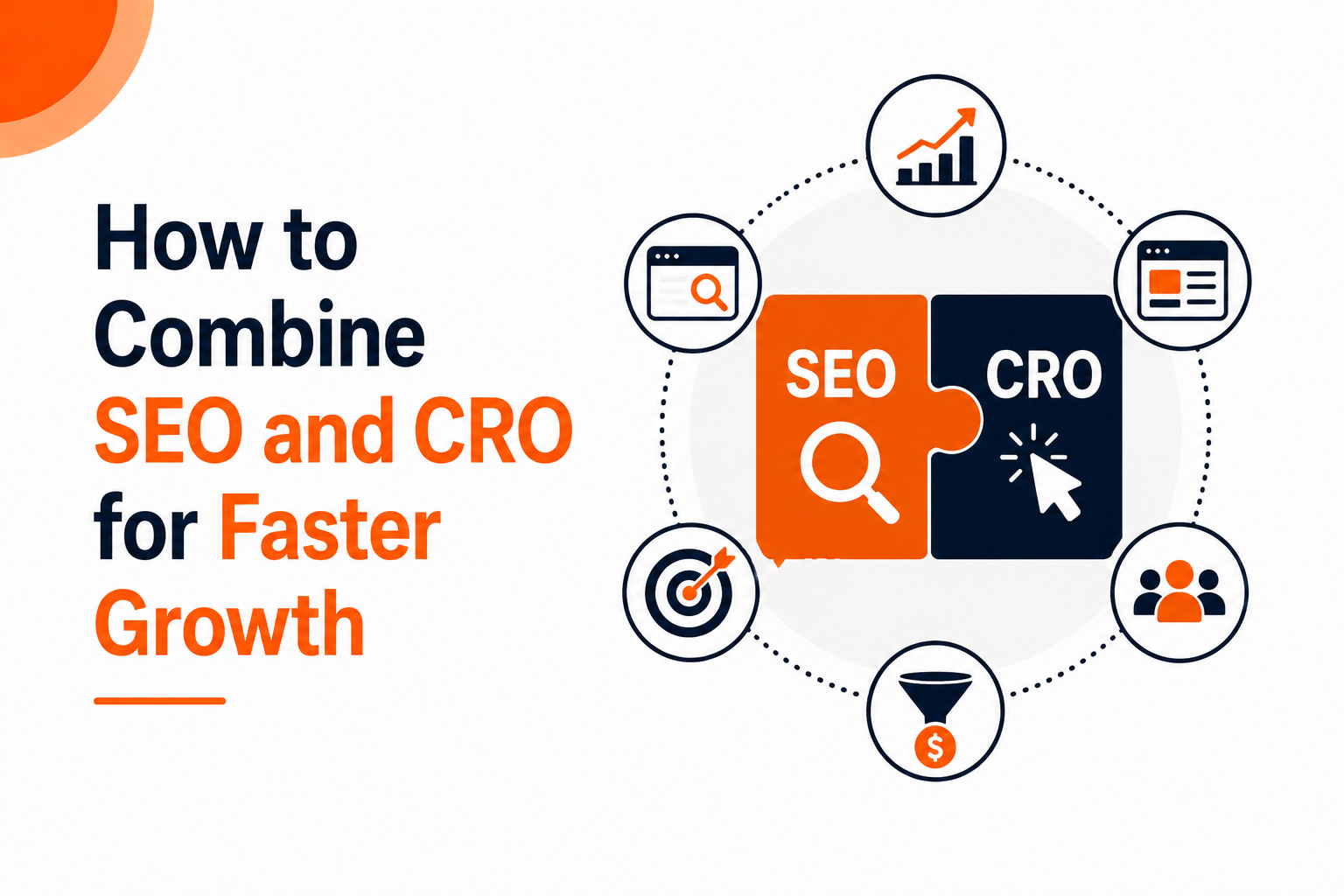
Most businesses treat SEO and CRO as separate disciplines managed by separate teams with separate goals, and that separation is exactly what slows growth down. When built into a unified strategy, organic search brings the right visitors to a website while conversion rate optimization determines what happens next. When these two functions share data, inform each other’s decisions, and work toward the same commercial outcomes, the compounding effect on revenue can be dramatic.
A business that ranks well but converts poorly is leaving most of the value of its organic visibility unrealized. A business that converts well but lacks organic traffic has optimized a leaky funnel without filling it. This article covers what CRO means in an SEO context, how to integrate the two disciplines effectively, and how Crescita Solutions builds combined SEO and CRO programs that produce measurable growth.
What Is CRO in SEO?
CRO stands for conversion rate optimization. In the context of SEO, it refers to the practice of improving the percentage of organic search visitors who take a desired action on a website, such as submitting a form, making a purchase, booking a call, or downloading a resource.
SEO and CRO operate on different parts of the same value chain. SEO focuses on attracting visitors through organic search. CRO focuses on converting those visitors into customers or leads. Neither discipline delivers its full potential without the other.
Several concepts sit at the intersection of SEO and CRO:
- Search intent alignment. A page that ranks for a specific query but fails to deliver what the searcher expected will generate high bounce rates and low conversions simultaneously. Aligning page content with the precise intent behind the queries driving organic traffic is both an SEO improvement and a CRO improvement at once.
- Page load speed. A slow loading page damages organic rankings through poor Core Web Vitals scores and suppresses conversions by frustrating visitors before they even read the content. Improving page speed serves both disciplines with the same fix.
- Content depth and clarity. Organic visitors who find exactly what they came for are more likely to engage further and convert. Content that answers the user’s question fully and then presents a clear, logical next step serves the SEO goal of satisfying search intent and the CRO goal of moving visitors toward conversion.
- Mobile experience. Search engines index the mobile version of pages first, making mobile optimization an SEO necessity. Mobile visitors also convert at significantly lower rates if checkout flows, forms, and navigation are not optimized for small screens. Mobile improvements produce gains in both channels.
- Trust signals. Content that ranks well earns clicks, but trust signals on the page, including credentials, testimonials, case studies, and security indicators, determine if an organic visitor converts after landing. Trust signals embedded in SEO optimized pages are a core CRO function that directly affects the commercial return on organic traffic.
SEO and CRO Integration
Integrating SEO and CRO starts with recognizing that both disciplines feed on the same data and serve the same ultimate goal: generating revenue from website traffic. The integration happens at the level of data sharing, shared goal setting, and coordinated experimentation.
Data sharing between SEO and CRO teams. SEO teams have access to Google Search Console data showing which queries bring visitors to which pages. CRO teams have access to behavioral data from heatmaps, session recordings, and conversion funnels. When these data sources are analyzed together, patterns emerge that neither team would identify in isolation. A page driving high organic traffic but low conversion signals a content or UX problem. A page with a high conversion rate but low organic traffic signals an SEO opportunity worth pursuing.
Shared goal setting. When SEO teams are measured only on rankings and traffic, and CRO teams are measured only on conversion rate, neither team is accountable for revenue. The integration of both disciplines means setting shared goals around qualified traffic and conversion outcomes, creating accountability for the full value chain from search impression to closed sale.
Coordinated experimentation. CRO relies on A/B testing and iterative experimentation to improve conversion rates. When these experiments run in coordination with SEO, they produce insights that inform both disciplines. Testing different calls to action on an organic landing page reveals not only which version converts better but also how changes to content depth or structure affect organic rankings over time.
User journey mapping. A full journey map of an organic visitor from their first search to their final conversion reveals the specific pages and decision points where visitors are most likely to drop off. This mapping exercise informs both the content strategy that brings visitors further into the site and the UX improvements that reduce friction at each stage of the journey.

SEO and CRO Strategy
A combined SEO and CRO strategy is built around four core activities: attracting the right visitors, delivering exactly what they came for, building enough trust to motivate action, and making the path to conversion as frictionless as possible.
The foundation of attracting the right visitors is keyword strategy. Not all organic traffic is equally convertible. Informational queries attract visitors who are early in their research process and are unlikely to convert on a first visit. Transactional and commercial investigation queries attract visitors who are closer to a decision and convert at significantly higher rates. A combined SEO and CRO strategy allocates content investment based on the commercial value of the organic traffic each keyword type produces, not just the volume.
Precise search intent matching is what determines if visitors find what they came for. Every landing page in the organic search funnel should be built around a specific intent, and the content, format, and structure of that page should reflect what a searcher with that intent actually wants to find. Intent mismatches are among the most common sources of both high bounce rates and low conversion rates in organic search programs.
Trust building on organic landing pages should be treated as a systematic process. This means identifying the specific trust signals most relevant to the audience landing on each page and incorporating them into the page design and content in ways that feel natural and credible. For B2B pages, this often means case studies, client logos, and specific outcome data. For eCommerce pages, it means product reviews, return policies, and visible security indicators.
Friction reduction on the conversion path involves removing every unnecessary step, field, or decision between an organic visitor and the action the page is asking them to take. Long forms, slow loading checkout processes, unclear calls to action, and poor mobile experiences are all friction sources that CRO testing can identify and eliminate, producing conversion rate improvements that directly multiply the revenue value of existing organic traffic.
SEO and CRO Services
Professional SEO and CRO services cover a spectrum of activities that span both disciplines, from technical site audits and keyword strategy to user experience testing and conversion funnel optimization.
Technical SEO and page experience services address the foundational elements that affect both search rankings and user behavior. Core Web Vitals optimization, mobile responsiveness improvements, site speed enhancements, and structured data implementation all fall into this category, producing gains that serve both organic visibility and conversion performance.
Content strategy and landing page development services produce organic landing pages built from the ground up around specific search intents, with conversion paths designed into the page structure from the start. This contrasts with the common approach of building SEO content first and bolting conversion elements on afterward, which consistently produces lower conversion rates than pages where both disciplines inform the design from the beginning.
Conversion rate testing services apply systematic A/B and multivariate testing to organic landing pages to identify the specific changes in headline, call to action, layout, social proof, or content depth that produce statistically significant improvements in conversion rate.
Analytics and attribution services build the measurement infrastructure that makes SEO and CRO integration possible at a practical level, connecting organic traffic data, behavioral data, and conversion data into unified reporting that gives businesses a complete view of how their organic search investment is translating into revenue.
Crescita Solutions: SEO and CRO Growth Agency
Crescita Solutions is a full service web design, development, and SEO company that builds integrated SEO and CRO programs for businesses across industries and geographies. The team operates from a foundational belief that organic traffic without conversion optimization is an incomplete investment, and conversion optimization without organic traffic is a well tuned machine with no fuel. Every engagement Crescita takes on is built to address both sides of that equation.
For businesses ready to combine SEO and CRO into a unified growth program, Crescita delivers:
- Full technical audits covering Core Web Vitals, page speed, mobile experience, and site architecture, addressing the foundational elements that affect both organic rankings and conversion performance simultaneously.
- Keyword and content strategies built around commercial intent, ensuring that organic traffic arriving on priority pages is composed of visitors who are close to a decision and more likely to convert.
- Landing page development that integrates search intent alignment, trust signal placement, and conversion path design from the outset, producing pages that rank and convert and not merely rank well without delivering commercial outcomes.
- Behavioral analytics setup including heatmaps, session recordings, and conversion funnel tracking that reveal exactly where organic visitors are dropping off and what changes would improve both engagement and conversion rate.
- A/B testing programs on organic landing pages that produce statistically reliable data on which content, design, and call to action elements produce the highest conversion rates from organic traffic.
- Unified reporting that connects organic traffic, rankings, behavioral data, and conversion outcomes into a single performance view, giving business leaders the information they need to make confident investment decisions across both disciplines.
For businesses ready to stop treating SEO and CRO as separate line items and start building them as a single, integrated growth engine, Crescita Solutions provides the strategic framework and execution capability to make that happen at a pace and scale that neither discipline could achieve on its own.