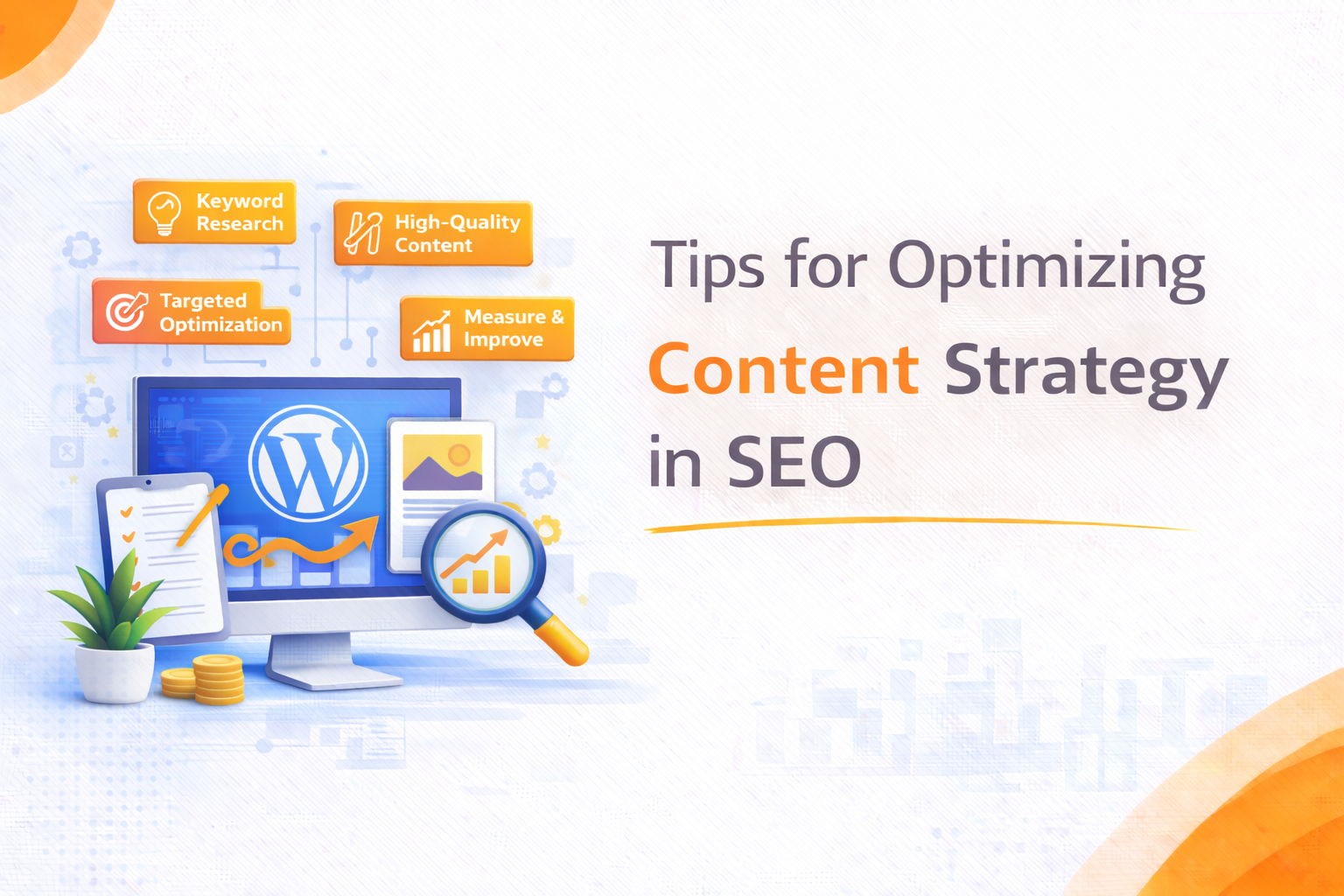
Tips for Optimizing Content Strategy in SEO
Publishing content without a strategy is one of the most common and costly mistakes businesses make in organic search. Topics get chosen based on what feels relevant, articles go live without proper keyword targeting, and months of publishing effort produce little to no movement in rankings or traffic. Optimizing a content strategy for SEO means building a system where every piece of content has a defined purpose, a target audience, a measurable search opportunity, and a clear connection to business goals. It means planning before producing, measuring consistently, and improving based on what the data shows.
These tips for optimizing content strategy in SEO are built for businesses that want their content investment to produce compounding organic returns, not just fill a publishing calendar.
Creating a Content Strategy for SEO
A content strategy for SEO starts with three things: understanding your audience, mapping the buyer journey, and identifying the search opportunities that exist at each stage. Without this foundation, content production becomes a volume game with no clear direction.
Define your audience with precision
Broad audience definitions produce broad content that ranks for nothing specific. The more precisely you can define who you are writing for, including their role, their problems, their level of knowledge, and the language they use when searching, the better your content will perform. For a B2B software company, “marketing professionals” is too broad. “E-commerce marketing managers at mid-sized retail brands troubleshooting low conversion rates” is a usable audience definition that shapes keyword choices, content depth, and tone.
Map content to the buyer journey
Every piece of content should serve a specific stage. Awareness-stage content targets people who have a problem but have not yet defined it clearly. Consideration-stage content targets people comparing solutions. Decision-stage content targets people ready to act. A content strategy with no decision-stage content leaves conversion traffic to competitors. A strategy with only decision-stage content misses the volume of traffic available at the top of the funnel.
Build topic clusters from the start
A topic cluster is a group of content pieces that cover a subject in depth, anchored by a pillar page that covers the broad topic and supported by cluster pages that go deep on specific subtopics. This structure builds topical authority, which is how Google identifies sites that are genuinely expert sources on a subject. Choose three to five core topic areas that align with your business, build a pillar page for each, and plan cluster content that fills out each topic systematically.
Prioritize based on search opportunity and business value
Not all content ideas are worth producing. Score each potential topic against two dimensions: the search volume and ranking difficulty for the target keyword, and the business value of ranking for that term. High search volume with low business value is a distraction. Moderate search volume with high business value is often the better investment. A content calendar built on this scoring approach produces better results than one built on intuition alone.
Set a publishing cadence you can sustain
Consistency matters more than volume. Two well-researched, properly optimized articles published every week will outperform six thin, poorly targeted posts published in a rush. Build a content calendar that reflects what your team can realistically produce at a high standard, then protect that standard as the calendar fills up.

Essential Tools for SEO Content Strategy
The right tools reduce the time spent on research and analysis, and improve the quality of decisions at every stage of the content process.
Ahrefs or Semrush for keyword research and competitive analysis
Both tools surface search volume, keyword difficulty, and related keyword clusters for any topic. The Content Gap feature in Ahrefs and the Keyword Gap tool in Semrush show which keywords your competitors rank for that you do not, which is one of the most direct ways to find content opportunities with proven demand.
Google Search Console for performance monitoring
Once content is live, Search Console shows exactly which queries it ranks for, what position it holds, how many impressions it generates, and what its click-through rate is. For content optimization, the most actionable data is pages that rank between positions 8 and 20 for valuable queries. These pages are close to meaningful traffic and often just need targeted improvements to move up.
Google Analytics 4 for outcome tracking
Traffic numbers without conversion context are incomplete. GA4 connects organic sessions to the actions that matter: purchases, form submissions, demo requests, and sign-ups. Content strategy decisions should be informed by which pieces produce outcomes, not just which ones generate the most pageviews.
AnswerThePublic or AlsoAsked for question research
These tools surface the specific questions people ask around a topic, which is useful for building FAQ sections, identifying blog post angles, and finding long-tail keyword opportunities that more competitive tools might overlook.
Content Marketing Strategy for SEO Success
Producing great content is only part of the equation. Getting that content to perform in organic search also involves distribution, promotion, and a commitment to ongoing optimization after publication.
Promote new content through internal linking immediately
When a new piece goes live, go into three or four existing pages that cover related topics and add contextual links to the new content. This gets the page into Google’s crawl queue faster and passes existing authority to the new piece from day one.
Update existing content regularly
Fresh, accurate content performs better in search than outdated pages. Build a quarterly review process where your team assesses the top-performing content pieces for accuracy, completeness, and alignment with current search intent. Updating a strong existing page is often faster and more effective than publishing a new one from scratch.
Build links to content pieces worth ranking
Content that earns backlinks from relevant, authoritative sites accumulates authority over time. Digital PR, outreach to industry publications, and producing original research or data studies are the most reliable methods for earning links to content. Identify the content pieces with the highest business value and prioritize link building efforts around those.
Track and report on content performance monthly
A content strategy without measurement has no feedback loop. Monthly reporting should cover organic sessions by content piece, ranking movement for target keywords, conversion rates from organic traffic, and new backlinks earned. This data tells you what is working, what needs improvement, and where to direct future content investment.
Align content production with seasonal and industry trends
Content planned around predictable search trends, product launches, industry events, and seasonal buying patterns captures traffic at the moments when intent is highest. Build these into the content calendar at least six to eight weeks in advance to give newly published content time to gain traction before the peak period arrives.
At Crescita Solutions, we build SEO content strategies that are grounded in data, aligned with business goals, and built to produce compounding organic growth over time. Every content piece we plan has a defined keyword target, a clear audience, and a measurable outcome it is designed to drive.
Our team handles the full process from topic research and content briefs through to publishing, optimization, and ongoing performance review. For businesses that want a content strategy built to rank and convert, Crescita Solutions brings the strategic depth and execution capability to make it happen.