5 Ways to Make a Small Business Website Rank on Google
For businesses with an online presence, achieving a high Google ranking can transform your website from a traffic struggle to a consistent source of new customers. Since most people begin their search for products, services, or information on Google, securing a spot on the first search results page is essential for success.
This guide simplifies the process of improving Google ranking into clear, practical steps that any small business owner can implement. We’ll avoid technical jargon and focus on actionable, effective advice on how small business website rank on google effectively.
Why Ranking On Google Matters For Your Small Business
The reason you are here is to improve your Google ranking. In this current world of AI, ranking high on Google is not the only way to get the best out of the platform; you need to be the answer that people trust. For a small business, high visibility on the first page is the difference between thriving and being digitally invisible.
1. Captured Intent (The “Ready-to-Buy” Audience)
Unlike social media, where people are browsing, Google users are searching with intent. When someone types in “emergency plumber near me” or “best organic bakery,” they have a specific problem and are ready to spend money. Ranking high puts you in front of that customer at the exact moment they are making a decision.
2. The “Trust” Factor
There is an unspoken psychological contract between Google and its users: consumers trust that the results on the first page are the most credible. In 2026, Google’s E-E-A-T (Experience, Expertise, Authoritativeness, and Trustworthiness) standards mean that a high ranking acts as a “seal of approval,” making customers more likely to choose you over a competitor on page two.
3. Dominating Local Discovery
For most small businesses, the Local Pack (the map results) is a goldmine. Ranking here is essential because:
- 46% of all Google searches have a local intent.
- Most mobile users will call or visit a business within 24 hours of finding it on a local search.
4. Compounding ROI
Unlike paid ads, which stop delivering the second you stop paying, organic ranking is a long-term asset. A well-ranked page can drive free, high-quality traffic for months or even years, significantly lowering your customer acquisition costs over time.
How to make Small Business Website Rank on Google
Step 1 – Keep your business information up to date On Your Google Business Profile
When a customer searches for a service or place near their location, they’ll find local results on Google Maps and Search. Having a Google Business profile that is up to date helps Google map you with the right set of customers. When a customer searches for something like “Fashion Designer” on their phone, Google aims to display relevant nearby businesses. The goal is to show customers options that they are likely to want to visit.
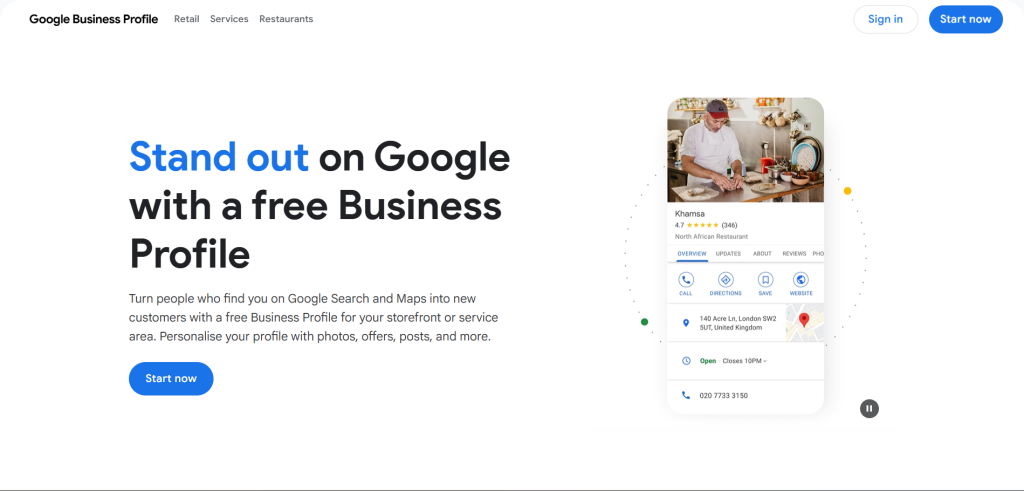
To appear in local search results for your area, your Business Profile must have complete and accurate information. Inaccurate business details can prevent your profile from showing up in relevant local searches.
To ensure customers have a complete understanding of your business—including your services, location, and operating hours—you should fully complete your Business Profile.
Key information to include is:
- Your complete business address, especially if customers can visit your physical location.
- Your phone number for contact.
- Your business category or type.
- Other essential amenities, such as details on parking or Wi-Fi access.
Step 2 – Publish Search Engine Optimised Content Relevant to Your Business
Once your website is live, the most effective way to attract high-quality traffic is by consistently publishing content that speaks directly to your audience’s needs. However, “just writing” isn’t enough—you need a strategy that satisfies both your readers and the search engines.
- Focus on Your Niche: Don’t try to be everything to everyone. To rank in 2026, you must establish Topical Authority. If you run a boutique fitness studio, your content should focus on local health tips, workout guides, and nutrition advice. This signals to Google that you are an expert in your specific field, making it more likely to show your site to interested users.
- Solve, Don’t Just Sell: Modern SEO is built on User Intent. Before writing, ask yourself: What is my customer searching for? By providing valuable answers to their questions, you build trust. Once a reader views you as a helpful resource, they are significantly more likely to convert into a paying customer.
- Optimize for “Humans First”: While keywords are important, Google’s latest algorithms prioritize Experience and Expertise (E-E-A-T). Your content should be:
- Scannable: Use clear headings, bullet points, and short paragraphs.
- Actionable: Give the reader a clear “next step.”
- Keyword-Smart: Naturally integrate terms your customers actually use without “stuffing” them in.
- The Consistency Compound Effect: SEO is a marathon, not a sprint. Every blog post, service page, or FAQ you publish is another “hook” in the water. Over time, these pages rank for different keywords, creating a steady stream of organic traffic that grows month over month without increasing your ad spend.
Crescita Solutions can set up and implement an appropriate SEO campaign for your business.

Step 3 – Have an Excellent User Experience to keep people on Your Website
Pro-Tips for Slashing Bounce Rates and Boosting Engagement. High traffic is meaningless if visitors leave seconds after arriving. To turn “browsers” into “buyers,” focus on these critical user experience (UX) pillars:
- Prioritize Mobile Excellence: Ensure your site is fully responsive. It should adapt seamlessly across all screen sizes, from high-end tablets to budget smartphones.
- Drive Action with Precise CTAs: Don’t leave users guessing. Use bold, clear calls-to-action (CTAs) like “Book Now” or “Shop the Collection” to guide the customer journey.
- Optimize for Speed: Every millisecond counts. Aim for a load time under 3 seconds by compressing images, streamlining plugins, and investing in premium hosting.
- Enhance Readability: Avoid dense walls of text. Utilize bullet points, short paragraphs, and strategic white space to make your insights “scannable.”
- Simplify Navigation: A frustrated user is a lost user. Keep your menus intuitive and include a visible search function for instant access to information.
Local Insight: For the local market, always test your site’s performance on 3G and 4G connections to ensure a smooth experience for users on various data plans.
Conversion Hack: Incorporate FAQs on your landing pages to handle objections in real-time and keep users on your site longer.
Step 4 – Build Relevant Backlinks
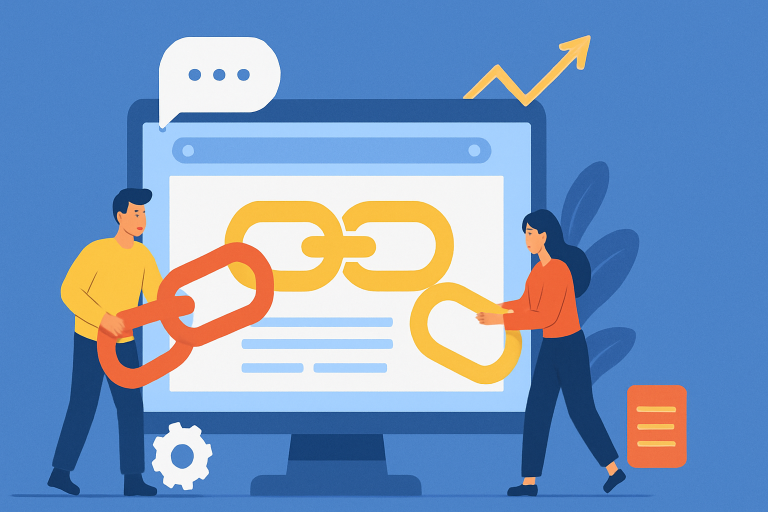
If your content is the “engine,” then backlinks are the “fuel.” A backlink occurs when another website links to yours. Google views these links as “votes of confidence”—the more high-quality votes you have, the more authoritative your site appears, and the higher you will rank.
However, quality outweighs quantity. Having 10 good links from reputable, industry-related sites is significantly better than 1,000 links from random, “spammy” sources.
How to Earn High-Quality Backlinks
- Create “Linkable Assets”: The easiest way to get a link is to create something worth sharing. This includes original research, detailed infographics, or comprehensive “how-to” guides that others in your industry will want to reference.
- Guest Posting with Purpose: Reach out to reputable blogs or news outlets in your niche. By providing a high-quality guest article, you can often include a link back to your site, reaching a new audience and boosting your SEO simultaneously.
- Fix Broken Links: Find websites that have broken links (links that lead to 404 error pages) relevant to your business. Reach out to the site owner and suggest they replace the broken link with a link to a relevant, high-quality page on your site.
- Local Partnerships & Directories: For small businesses, getting links from local chambers of commerce, community blogs, or niche-specific directories (like Yelp or TripAdvisor) is a powerful way to dominate local search results.
The “Relevance” Rule
Always ask: Does this link make sense? If you own a bakery, a link from a food blogger is incredibly relevant and powerful. A link from an auto-repair shop, however, won’t carry much weight. Google’s algorithms are now smart enough to understand the context of a link, so stay focused on your specific industry.
Avoid “Black Hat” Shortcuts
Never buy links or participate in “link farms.” While it might seem like a quick way to the top, Google’s AI-driven spam detection is highly effective. These shortcuts can lead to your website being penalized or entirely removed from search results, undoing all your hard work.
Step 5 – Master On-Page SEO Basics
While backlinks build your reputation, On-Page SEO is how you tell Google exactly what your website is about. It involves optimizing individual pages so search engines can crawl, index, and understand your content efficiently. Think of it as organizing a library so readers can find the right book instantly.
Here are the essential “on-page” elements every small business should master:
1. Craft Compelling Title Tags and Meta Descriptions
These are the first things a user sees on the Google results page.
- Title Tags: Keep these under 60 characters and include your primary keyword (e.g., Best Custom Cakes in Los Angeles| [Your Business Name]).
- Meta Descriptions: This is your 150-character “sales pitch.” Summarize the page and include a call-to-action to encourage clicks.
2. Use a Logical Heading Hierarchy (H1, H2, H3)
Headings aren’t just for styling; they create a roadmap for Google.
- H1: Use only one per page for your main title.
- H2 & H3: Use these for sub-topics to break up text and include secondary keywords naturally.
3. Optimize Your Images with Alt Text
Search engines can’t “see” images, but they can read the code behind them. Alt Text describes an image to Google and improves accessibility for visually impaired users. Instead of naming a file IMG_1234.jpg, use oven-baked-velvet-cake-in-LA.jpg.
4. Strategic Keyword Placement
Gone are the days of “keyword stuffing.” Today, you should place your main keyword in the first 100 words of your content and sprinkle related terms throughout. The goal is to sound natural and helpful, not like a robot.
5. Internal Linking
Don’t let your pages be “islands.” Link to other relevant pages on your own site. For example, if you’re writing a blog post about How To Make Vanilla Cake, link it to your Cake R page. This keeps visitors on your site longer and shares “ranking power” between your pages.
6. Clean URL Structures
A clean, readable URL is better for both users and SEO.
- Bad: yoursite.com/p=123?category=abc
- Good: yoursite.com/cake-home-recipe
In Conclusion: Turning Steps into Success
Achieving a high Google ranking is no longer a luxury—it’s the foundation of digital visibility for any small business. The journey from invisible to indispensable can be built on five core pillars: maintaining an accurate Google Business Profile, consistently publishing SEO-Optimized Content, delivering an Excellent User Experience, building high-quality and Relevant Backlinks, and mastering the On-Page SEO Basics.
These steps form a compounding, long-term asset that drives free, high-quality traffic for years. While you can implement these strategies yourself, they require time, technical know-how, and constant adaptation to Google’s evolving algorithms.
If you are ready to accelerate your growth and secure your place on the first page of search results, the most effective path is partnering with an expert. Crescita Solutions specializes in translating these complex SEO principles into tangible results. We can set up and implement an appropriate SEO campaign for your business, ensuring every step, from optimizing your Business Profile to building your linkable assets, is executed with professional precision. By leveraging our expertise, you can focus on running your business while a dedicated strategy turns your website into a powerful, customer-generating machine.