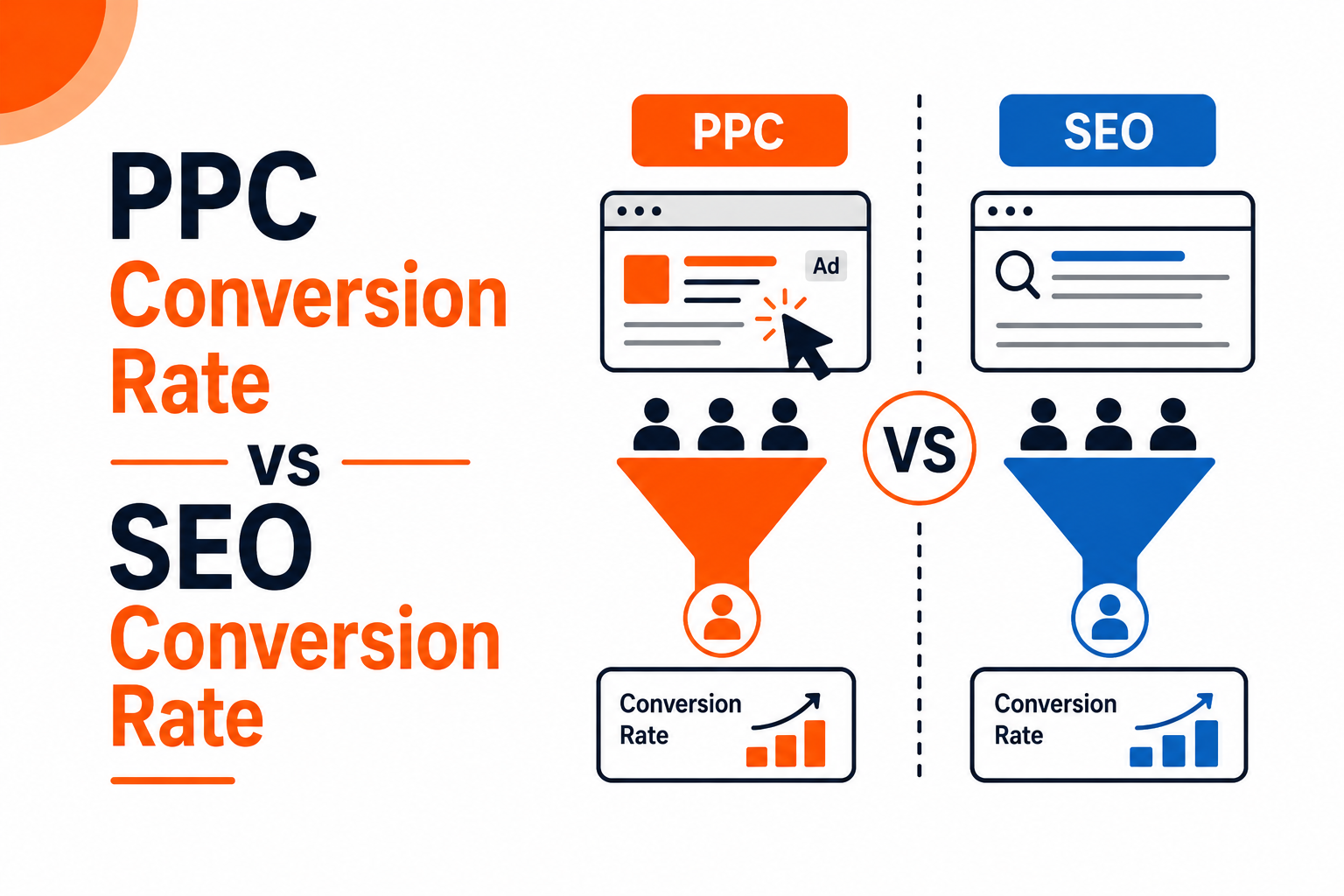
PPC Conversion Rate vs SEO Conversion Rate: What Is the Difference?
The gap between PPC and SEO conversion rates is one of the most useful distinctions a digital marketer can internalize, because the two channels attract different buyers at different stages of intent, and treating their conversion metrics as interchangeable produces flawed conclusions and misallocated budgets.
The conversion rate from organic search and the conversion rate from paid search are both important performance indicators, but they measure different things, reflect different audience behaviors, and respond to different optimization levers. This article breaks down how conversion rate works in each channel, what eCommerce benchmarks look like for organic search, how the two channels compare directly, and how Crescita Solutions helps businesses get the most out of both.
What Is Conversion Rate in SEO??
In SEO, conversion rate is the percentage of organic search visitors who complete a desired action on a website. That action could be a product purchase, a form submission, a phone call, a content download, a demo request, or any other outcome the business has defined as a conversion goal.
The formula is straightforward: divide the number of conversions from organic traffic by the total number of organic sessions, then multiply by one hundred to get a percentage. A page that receives one thousand organic visitors in a month and produces thirty conversions has a three percent conversion rate from organic search.
Several factors shape how SEO conversion rates perform in practice:
- Landing page relevance. When the page a visitor lands on directly addresses the search query that brought them there, conversion rates improve significantly. A mismatch between search intent and landing page content is one of the most common reasons organic traffic converts poorly.
- Funnel stage of the organic visitor. SEO attracts visitors across the full spectrum of buyer readiness, from someone who just became aware of a problem to someone actively comparing products before a purchase. Top of funnel organic visitors convert at lower rates than bottom of funnel visitors because they are earlier in their decision process.
- Page load speed and user experience. Slow loading pages, confusing navigation, and poor mobile experiences all suppress conversion rates from organic traffic regardless of how well the page ranks or how relevant the content is.
- Trust signals on the page. Reviews, testimonials, credentials, security badges, and clear contact information all increase the likelihood that an organic visitor takes action, particularly on high consideration purchases.
- Call to action clarity. A page that ranks well and attracts qualified traffic but fails to present a clear, compelling next step leaves conversion potential unrealized. The call to action must align with where the visitor is in their decision process.

Average Conversion Rate E commerce from SEO
E commerce conversion rates from organic search fall in a well documented range, though the actual figures for any given store depend heavily on product category, price point, brand recognition, and the quality of the landing pages receiving organic traffic.
Across eCommerce broadly, organic search conversion rates tend to sit between two and four percent, with top performing stores in highly optimized categories reaching five percent or above. These figures compare favorably to direct traffic in many categories and outperform social media traffic by a significant margin in most eCommerce verticals.
Several eCommerce specific factors influence where a store falls within that range:
- Product category. Low cost, high frequency purchase categories like consumables and household goods convert at higher rates than high consideration categories like furniture, electronics, or luxury goods, where the research cycle is longer and multiple sessions precede a purchase.
- Brand awareness. Shoppers who arrive at an eCommerce site through branded organic search terms, meaning they searched for the store by name, convert at dramatically higher rates than those arriving through non branded category or product terms. The two groups should be analyzed separately for accurate performance assessment.
- Mobile vs desktop traffic split. Mobile organic traffic consistently converts at lower rates than desktop traffic in eCommerce, largely because checkout experiences on mobile remain more friction heavy than on desktop for many stores. Stores with optimized mobile checkout narrow this gap considerably.
- Seasonal demand patterns. Conversion rates from organic search fluctuate significantly around peak shopping periods. A year over year lens produces more useful insight than month to month comparisons that conflate seasonal effects with true performance changes.
PPC Conversion Rate vs SEO Conversion Rate
A direct comparison of PPC and SEO conversion rates reveals meaningful differences that have significant implications for how budgets should be allocated and how each channel should be optimized.
PPC conversion rates in eCommerce and lead generation contexts tend to run higher than SEO conversion rates, often in the range of three to six percent for well managed campaigns compared to two to four percent for organic search. Several structural reasons explain this gap.
Intent precision. Paid search allows advertisers to target extremely specific, high intent search terms and control exactly which page a visitor lands on after clicking. This level of control over the intent to landing page match is harder to achieve consistently in organic search, where ranking for a specific term does not guarantee the searcher’s intent aligns perfectly with the page they land on.
Ad copy as a pre qualifier. A paid search ad gives the advertiser the opportunity to set expectations before a visitor clicks. Ad copy that clearly states pricing, audience fit, or offer specifics pre qualifies the click, meaning visitors who arrive via paid search have already self selected based on the ad’s messaging. Organic search visitors arrive with no such pre qualification beyond what the title tag and meta description communicate.
Landing page control. PPC campaigns routinely use dedicated landing pages built specifically for conversion, stripped of navigation and competing calls to action. Organic search more often lands visitors on broader pages that serve multiple purposes, which produces lower conversion rates than a purpose built paid landing page.
Where SEO Holds the Advantage
PPC conversion rates may be higher on average, but several factors make organic search conversion data more strategically valuable over time.
Cost per conversion. A three percent conversion rate from organic traffic costs nothing per click. A five percent conversion rate from PPC costs whatever the cost per click rate dictates across the full volume of traffic. In competitive categories where cost per click rates are high, organic search frequently produces a lower cost per conversion in spite of the lower conversion rate.
Traffic quality at scale. Organic search can attract enormous traffic volumes to informational and educational content that paid search cannot efficiently monetize. That traffic, even at lower conversion rates, builds brand familiarity, email lists, and remarketing audiences that improve paid search performance downstream.
Compounding returns. Paid search stops producing results the moment the budget is paused. Organic search builds an asset that continues generating traffic and conversions indefinitely, making the long term cost per conversion from SEO far lower than in period figures suggest.
Crescita Solutions: SEO and PPC Conversion Rate Optimization
Crescita Solutions is a full service web design, development, and SEO company that helps businesses improve conversion rates across both organic and paid search channels through a unified, data driven approach. The team understands that conversion rate optimization is not a paid search only discipline; it is as important in organic search as in any paid channel, and the two should inform each other continuously.
For businesses looking to close the conversion rate gap between their SEO and PPC programs, Crescita delivers:
- Landing page audits for organic search that identify the specific friction points, intent mismatches, and call to action weaknesses suppressing conversion rates on high traffic organic pages.
- Technical performance optimization covering page load speed, Core Web Vitals, and mobile experience across the pages receiving the most organic traffic, since user experience directly affects conversion outcomes.
- Search intent mapping that aligns every organic landing page with the precise stage of buyer intent reflected in the queries driving traffic to it, improving the relevance match that underpins conversion performance.
- Unified reporting across paid and organic search that presents conversion rate data from both channels in context, making it possible to identify where each channel is over or underperforming and adjust investment accordingly.
- Full funnel content programs that move organic visitors from informational searches toward conversion oriented pages through deliberate internal linking, contextual calls to action, and content sequencing built around the buyer journey
- Conversion rate benchmarking against industry standards that gives businesses a realistic picture of where their organic and paid performance sits relative to comparable competitors, and a prioritized plan for closing any identified gaps
For businesses ready to treat organic search with the same conversion discipline applied to paid campaigns, Crescita Solutions provides the analytical rigor and execution capability to make that standard a reality across every channel.