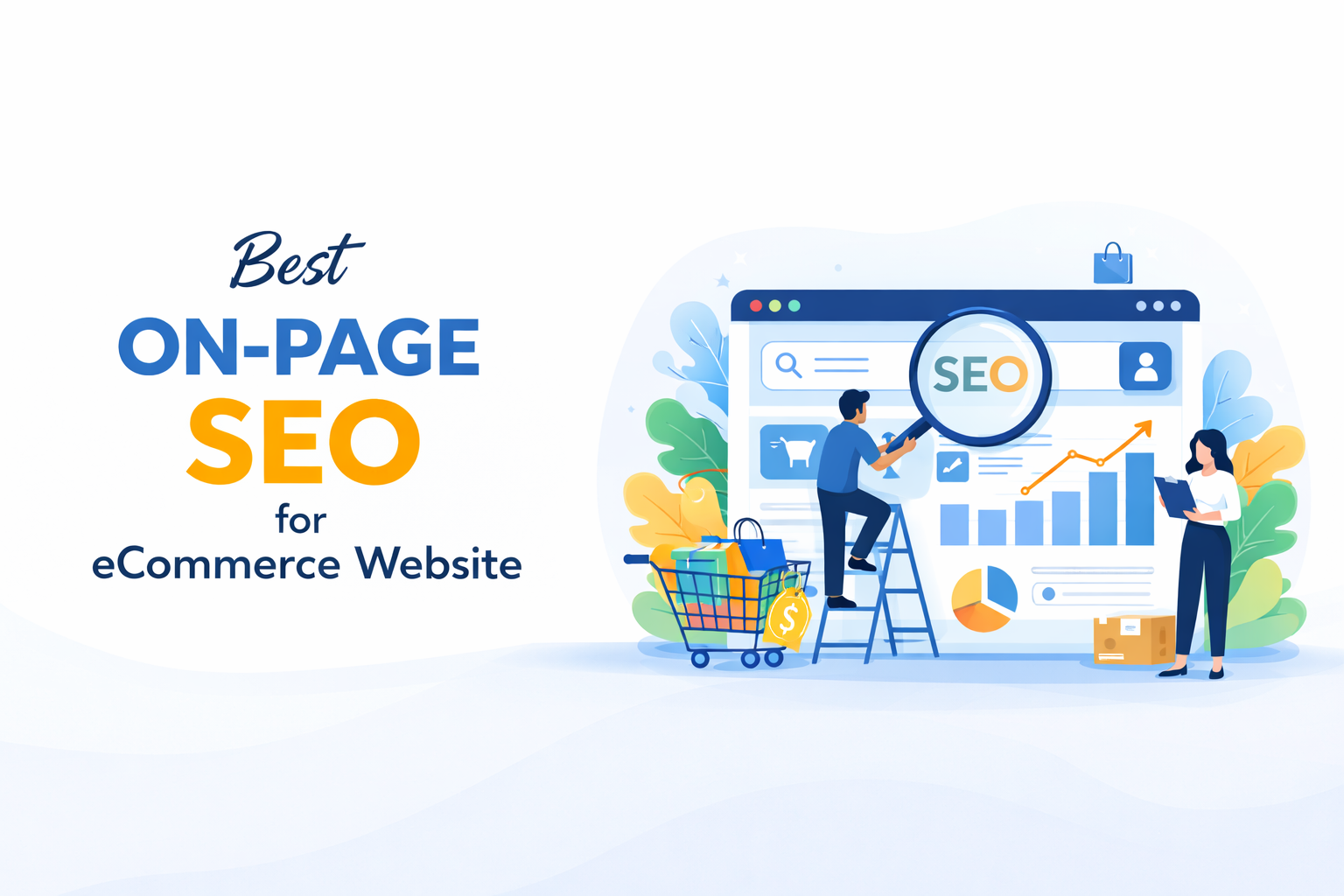
Best On-Page SEO for eCommerce Website
Running an eCommerce store without investing in on-page SEO is the equivalent of stocking a shop, hiring staff, and then boarding up the windows. The product is there. The infrastructure is there. But the customers cannot find it. On-page SEO for eCommerce websites is what makes a store visible to the people who are actively searching for what it sells, at the exact moment they are ready to buy. It is not a one-time setup task. It is an ongoing discipline that compounds over time, building organic visibility across hundreds or thousands of product and category pages that would otherwise sit invisible in a search index.
The best on-page SEO for eCommerce websites combines technical precision with content strategy and conversion thinking, treating every page as both a ranking asset and a selling tool. Crescita Solutions builds and optimizes eCommerce sites with that standard applied from the ground up.
Is On-Page Content Important for Ecommerce SEO?
The short answer is yes, and the longer answer is that on-page content is one of the most underinvested areas in eCommerce SEO and one of the highest-return opportunities available to stores that get it right.
There is a persistent misconception in eCommerce that product images and prices do the selling, so content is secondary. That logic holds for a visitor who has already arrived on the page. It does not hold for getting that visitor there in the first place.
Why content drives eCommerce rankings
Search engines rank pages based on their ability to satisfy the intent behind a search query. A product page with a manufacturer’s description, a price, and three images gives search engines very little to work with. A product page with a detailed description covering materials, dimensions, use cases, compatibility, care instructions, and answers to the questions buyers commonly ask gives search engines a page worth ranking and gives buyers a reason to purchase without leaving to do more research elsewhere.
Category pages carry even more ranking potential than individual product pages in most eCommerce sectors, and they are even more consistently neglected. A category page for running shoes that contains nothing but a grid of products is competing against category pages with buying guides, brand comparisons, sizing advice, and curated editorial content. The stores investing in that content win the rankings and the traffic.
Content and conversion work together
On-page content in eCommerce is not purely an SEO exercise. The same content that helps a page rank also reduces purchase hesitation, answers pre-sale questions that would otherwise go to customer support, and builds confidence with buyers who are evaluating multiple options. Better content produces better rankings and better conversion rates, which makes it one of the most commercially efficient investments an eCommerce business can make.
Thin content as a ranking suppressor
Google’s quality assessment systems actively identify and discount thin content. E-ommerce sites with large catalogs of near-identical product pages, where only the product name and a few specifications change between pages, are particularly vulnerable to thin content penalties. A site-wide thin content issue suppresses rankings across the entire domain, not just on the affected pages.
On-Page SEO Checklist for E-commerce Website
A structured on-page SEO checklist for eCommerce covers both the elements that apply across every page type and the specific requirements of product pages, category pages, and other key page templates.
Site-wide on-page foundations
- Title tags are unique across every page, front-loaded with the primary target keyword, and written to attract clicks as well as rank.
- Meta descriptions are present on every indexable page, written as concise summaries that give searchers a clear reason to click.
- H1 tags are present on every page, contain the primary target keyword, and appear only once per page.
- H2 and H3 tags structure the content logically and incorporate secondary and supporting keywords naturally.
- Images across the site carry descriptive, keyword-informed alt text that accurately describes the image content.
- Internal linking connects related products, related categories, and supporting content in a way that distributes authority and helps visitors find relevant pages.
- Page URLs are clean, descriptive, and free of unnecessary parameters, session IDs, or auto-generated strings.
- Canonical tags are correctly configured to prevent duplicate content issues from URL variations.
Product page on-page SEO
- Each product page targets a specific primary keyword based on how buyers search for that product, not the internal product name the business uses.
- Product descriptions are original, detailed, and written for the buyer, not copied from manufacturer specifications.
- Product schema markup is implemented correctly covering name, price, availability, and reviews, and validated against Google’s rich result specifications.
- Review content is present and marked up correctly, since review-rich snippets improve click-through rates measurably.
- Related product sections are internally linked with descriptive anchor text.
- Out of stock products have a clear strategy covering temporary unavailability messaging, canonical handling, and the protocol for discontinued lines.
Category page on-page SEO
- Each category page has a unique H1 and introductory content block that establishes topical relevance for the category’s target keywords.
- Category descriptions are placed either above the product grid or below it, depending on the impact on user experience, but are present and substantial enough to provide ranking signals.
- Faceted navigation filters are handled with canonical tags or no-index directives to prevent crawl budget waste and duplicate content.
- Pagination is configured correctly so search engines can discover all products in the category.
- Breadcrumb navigation is present, structured correctly, and marked up with breadcrumb schema.
Supporting content on-page SEO
- Blog posts and buying guides are internally linked to the relevant product and category pages they support.
- FAQ content on product and category pages targets the question-format searches that appear in People Also Ask boxes.
- Landing pages for promotional events or seasonal campaigns are handled correctly to preserve equity when the campaign ends.
Off-Page vs On-Page SEO for E-Commerce
Understanding the relationship between on-page and off-page SEO for eCommerce is important for allocating budget and effort in the right proportions at each stage of a store’s development.
On-page SEO: The foundation
On-page SEO covers everything within your direct control on the site itself. Content, structure, metadata, internal linking, schema markup, and page experience signals are all on-page factors. They determine how well search engines understand what your pages are about and how relevant they are to specific queries.
For eCommerce stores, on-page SEO is the prerequisite for everything else. A store with weak on-page foundations will not get full value from off-page investment because the pages being linked to are not set up to rank effectively. Getting on-page right first is not just good practice. It is the logical sequence.
Off-page SEO: Building authority
Off-page SEO covers the signals that exist outside your site, primarily links from other websites pointing to your pages and domain. These links pass authority and act as votes of confidence in the quality and relevance of your content. In competitive eCommerce markets, a strong link profile is often the deciding factor between two sites with similar on-page quality.
Off-page SEO for eCommerce includes:
- Digital PR campaigns that earn links from publications covering your product category or industry.
- Supplier and manufacturer links from brand pages pointing to authorized retailers.
- Affiliate and partner link relationships managed with attention to quality and relevance.
- Content marketing that earns links organically through buying guides, research pieces, and resources that other sites reference.
How they work together
On-page and off-page SEO are not competing priorities. They are sequential and complementary ones. A new eCommerce store should invest heavily in on-page foundations first, building a site structure and content base that is worth linking to. As the site matures and on-page quality is established, off-page investment amplifies what on-page has built, pushing well-optimized pages up the rankings they are already positioned to occupy.
Splitting budget equally between on-page and off-page from day one, before the on-page foundation is solid, produces weaker results from both investments. The stores that grow organic traffic most efficiently invest in sequence, not in parallel from the start.
Where eCommerce stores get the balance wrong
The most common mistake is investing in link building before the product and category pages are properly optimized. Links pointing to thin, poorly structured pages produce limited ranking improvement because the destination is not good enough to hold a top position. The second most common mistake is the opposite: investing heavily in on-page content on a new domain with no authority and expecting rankings to follow quickly. Both on-page quality and off-page authority are necessary. The question is sequencing, not choosing one over the other.
Crescita Solutions: On-Page SEO for E-Commerce Built Into Every Project
E-commerce on-page SEO produces its best results when it is built into the site from launch, not retrofitted onto a store that was designed without search performance in mind. Crescita Solutions integrates on-page SEO into every eCommerce build, which means product pages, category pages, and site architecture are structured, optimized, and ready to rank from the day the store goes live.
For established eCommerce businesses with existing stores, Crescita delivers structured on-page audits covering the full range of factors that affect search visibility, from title tag quality and content depth through to canonical configuration and schema implementation. Every audit produces a prioritized action plan tied to commercial outcomes, so the work addresses the issues with the highest impact on traffic and revenue first.
Crescita works across eCommerce platforms including Shopify, WooCommerce, Magento, and custom builds, with the technical depth to implement on-page recommendations correctly regardless of the platform constraints involved. The team understands that eCommerce SEO operates at scale, and that the systems and processes for maintaining on-page quality across large catalogs are as important as the individual page optimizations. If your eCommerce store is not generating the organic traffic its product range deserves, Crescita Solutions is the partner to change that.