Best Enterprise SEO Strategy for Large Companies
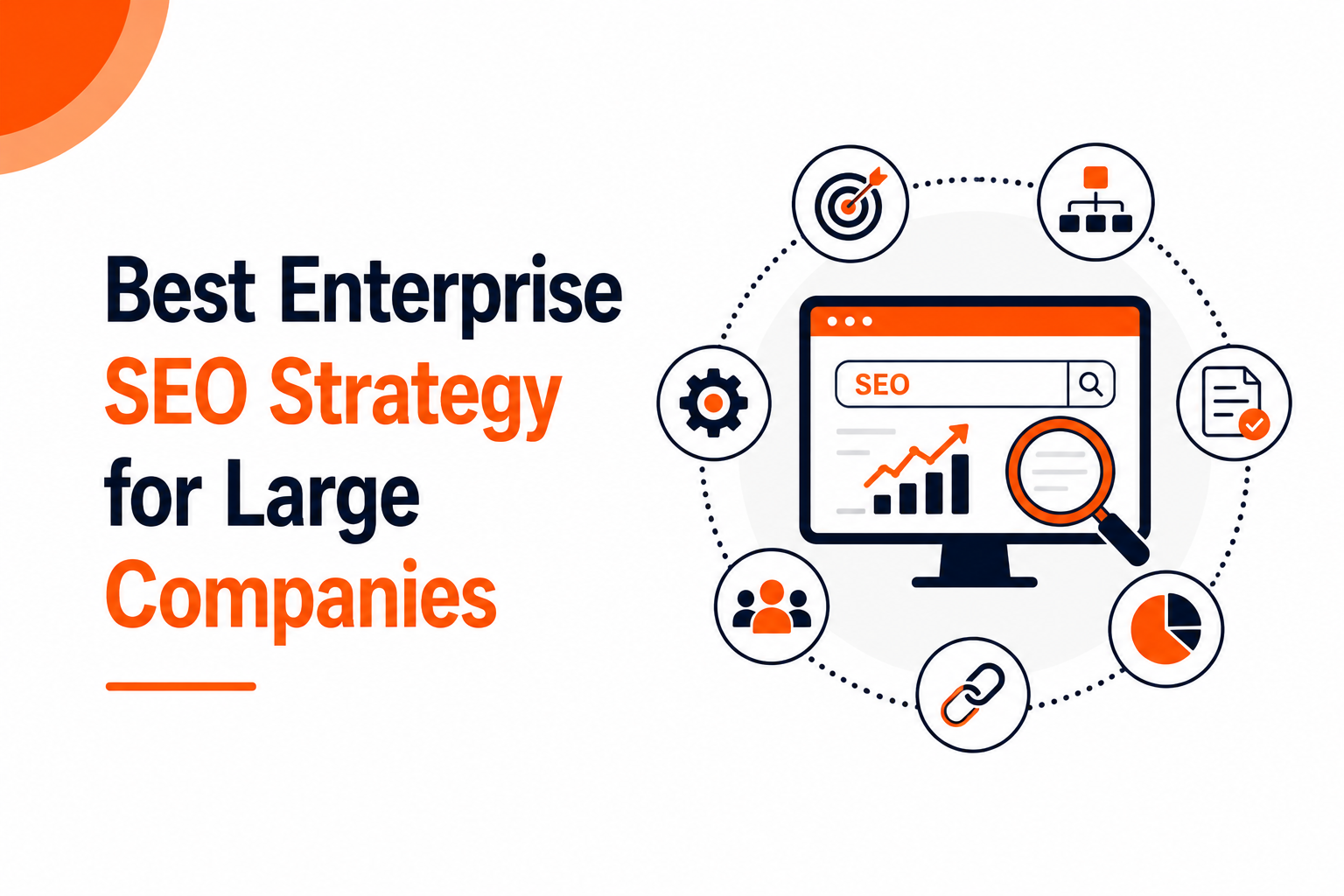
Developing and executing an enterprise SEO strategy for large companies demands a level of operational discipline, technical sophistication, and cross-functional coordination that goes well beyond what works for small or mid-sized businesses. Large companies deal with website architectures containing thousands or tens of thousands of pages, multiple stakeholder groups with competing priorities, legacy technical debt that accumulated over years of uncoordinated development, and competitive search environments where every ranking position is contested by equally resourced opponents.
At this scale, SEO is not a marketing side project; it is a revenue infrastructure decision. The companies that treat it that way, investing in the right tools, the right processes, and the right agency partners, build organic search presences that generate compounding returns across every business unit, product line, and geographic market they serve. This article breaks down the most effective enterprise SEO strategies across SaaS, automated workflows, and eCommerce, and explains what large companies should expect from a world-class SEO partner.
Enterprise SEO Strategy for SaaS
SaaS companies operating at enterprise scale face a specific and demanding set of SEO challenges. Product lines evolve rapidly, feature sets expand, new markets open up, and the content infrastructure must keep pace with all of it without losing the topical authority and technical integrity already built into the domain.
Topical Authority
Enterprise SaaS companies need to own entire topic clusters, not just individual keywords. A topical authority strategy builds interconnected content ecosystems around the core problems the software solves, with pillar pages covering broad subjects and cluster content addressing every specific question, use case, and sub-topic within that subject. At enterprise scale, this means managing content libraries of hundreds or thousands of interlinked pages, each one serving a specific search intent while feeding authority back to the broader cluster.
Product-Led SEO
One of the most powerful strategies available to enterprise SaaS companies is product-led SEO, where the product itself generates indexable, rankable content. User-generated content, public-facing dashboards, template libraries, integration pages, and use case directories can all be structured to attract organic traffic at a scale that editorial content alone could never match. When built with proper canonical structures, indexation controls, and quality signals, product-led SEO pages become one of the highest-volume traffic channels in an enterprise SaaS company’s organic portfolio.
Internationalization and Hreflang
Enterprise SaaS companies serving global markets must implement hreflang correctly across their entire site to ensure that search engines serve the right language and regional version of each page to the right audience. Hreflang errors at scale can produce duplicate content problems, cannibalization between regional variants, and ranking suppression in target markets.
Crawl Budget Management
SaaS platforms with extensive feature documentation, integration directories, or knowledge bases often generate enormous numbers of URLs through faceted navigation and filtering systems. Without proper crawl budget management, search engines waste their crawl allocation on low-value parameter URLs while missing the high-value pages that should be ranking. Implementing crawl directives through robots.txt, canonical tags, and URL parameter handling in Search Console is essential at this scale.

Automated SEO Strategy for Enterprise
At enterprise scale, manual SEO processes create bottlenecks that limit what is achievable. Automation is not a shortcut; it is a structural necessity for organizations managing large websites, multiple markets, and high content production volumes.
Automated Technical Auditing
Enterprise websites change constantly. Development teams push updates, new pages are created, redirects are added, and site architecture evolves. An automated technical auditing system that runs continuous crawls and alerts SEO teams to newly introduced issues, broken internal links, indexation drops, or Core Web Vitals regressions is the only practical way to maintain technical health at scale.
Programmatic Content at Scale
Programmatic SEO allows enterprise companies to generate large volumes of targeted landing pages from structured data sets. A logistics company might build individual pages for every origin-destination shipping route it serves. A recruiting platform might generate pages for every job category in every city. When programmatic pages are built with informational depth and structured correctly, they can capture enormous amounts of long-tail organic traffic that would be impossible to pursue through manual content production alone.
Automated Rank Tracking and Reporting
Enterprise SEO programs track hundreds or thousands of keywords across multiple markets and devices. Automated rank tracking systems pull this data daily, feed it into reporting dashboards, and surface the movements that demand attention, without requiring analysts to manually compile spreadsheets. Integration with Looker Studio allows leadership teams to see SEO performance alongside other business metrics in a unified view.
Workflow Automation for Content Operations
Content production at enterprise scale involves writers, editors, SEO specialists, legal reviewers, and publishing teams, all of whom need to move efficiently through a coordinated workflow. Automating brief generation, internal linking suggestions, content scoring against SEO benchmarks, and publishing checklists removes friction from the production process and ensures consistency across a high-volume content operation.
Log File Analysis
Server log file analysis reveals exactly how search engine crawlers are interacting with a site, which pages they are visiting most frequently, which are being ignored, and where crawl budget is being wasted. At enterprise scale, this analysis surfaces patterns invisible to standard crawling tools and informs crawl budget optimization decisions that can meaningfully accelerate indexation of priority content.
SEO Strategy for Enterprise E Commerce
Enterprise eCommerce presents some of the most technically complex SEO challenges in the industry. Large product catalogs, dynamic inventory, faceted filtering systems, user-generated review content, and aggressive competition from marketplaces all create a demanding environment where technical precision and content quality must operate at an exceptionally high standard.
Category Page Optimization
Category pages are the highest-value organic landing pages on most eCommerce sites. At enterprise scale, optimizing hundreds of category pages requires a templated approach that is flexible enough to accommodate unique content for each category while maintaining consistent technical standards. Each category page should include unique introductory copy, well-structured internal links to subcategories and related products, and keyword targeting informed by actual search demand in that product space.
Faceted Navigation Control
Faceted filtering systems, where users filter products by size, color, price, brand, or other attributes, generate enormous numbers of URL combinations. Without proper controls, these pages cause duplicate content problems, cannibalize each other’s rankings, and consume crawl budget that should be allocated to priority pages.
Product Page SEO at Scale
Enterprise eCommerce sites with tens of thousands of product pages cannot rely on manual optimization for each one. A templated on-page optimization system, where product titles, meta descriptions, and structured data are generated dynamically from product database fields, applies consistent SEO standards across the entire catalog. Human optimization effort is then reserved for the highest-traffic, highest-revenue product pages where custom copy produces the greatest return.
Review Content as an SEO Asset
User-generated review content on product pages introduces fresh, keyword-rich text that search engines reward with improved rankings over time. Enterprise eCommerce companies that encourage and display reviews systematically across their catalog benefit from a continuous content update signal that static product descriptions alone cannot provide.
Out-of-Stock and Discontinued Product Management
Managing the SEO implications of inventory changes is a persistent challenge for enterprise eCommerce. Pages for out-of-stock products should be maintained with updated messaging where inventory will return, redirected to the closest alternative where the product is permanently discontinued, or preserved as informational pages if they carry significant backlink equity.
Marketplace Competition Strategy
Enterprise eCommerce companies competing against Amazon and other marketplace giants for product keyword rankings need a differentiated content strategy. Competing head-to-head on generic product terms is rarely productive. Winning organic strategies focus on brand-specific searches, editorial content that contextualizes products within buyer needs, comparison content that positions the brand’s catalog against alternatives, and long-tail product queries where marketplace competition is thinner.
Crescita Solutions: Enterprise SEO Agency for Large Companies
Crescita Solutions brings the technical depth, strategic rigor, and cross-functional coordination that enterprise SEO programs demand. Large companies working with Crescita get more than an agency executing a checklist; they get a partner that understands the internal complexity of large organizations and builds SEO programs designed to operate effectively within that reality.
For enterprise clients, Crescita delivers:
- Full-scale technical SEO audits covering site architecture, crawl budget, Core Web Vitals, internationalization, and indexation across large, complex websites.
- Topical authority strategies built around the specific product lines, markets, and buyer personas the organization serves.
- Programmatic SEO consulting for companies looking to scale content and landing page volume through structured data.
- On-page optimization systems and templates that apply consistent SEO standards across high page-count environments.
- Content strategy and production for pillar pages, cluster content, and category-level editorial that builds compounding organic authority.
- Automated reporting infrastructure that connects SEO performance to revenue metrics and presents data in formats accessible to leadership teams.
- Link building through credible, industry-relevant publications and media outlets at the volume enterprise authority-building programs need.
Crescita’s approach to enterprise SEO is built on one foundational principle: organic search at scale should function as a revenue infrastructure asset, not a marketing expense. Every technical fix, every content investment, and every link earned contributes to a compounding organic presence that grows in value over time and delivers returns that paid channels structurally cannot match. For large companies ready to build that kind of presence with a partner that operates at enterprise standards, Crescita Solutions is the team to do it.