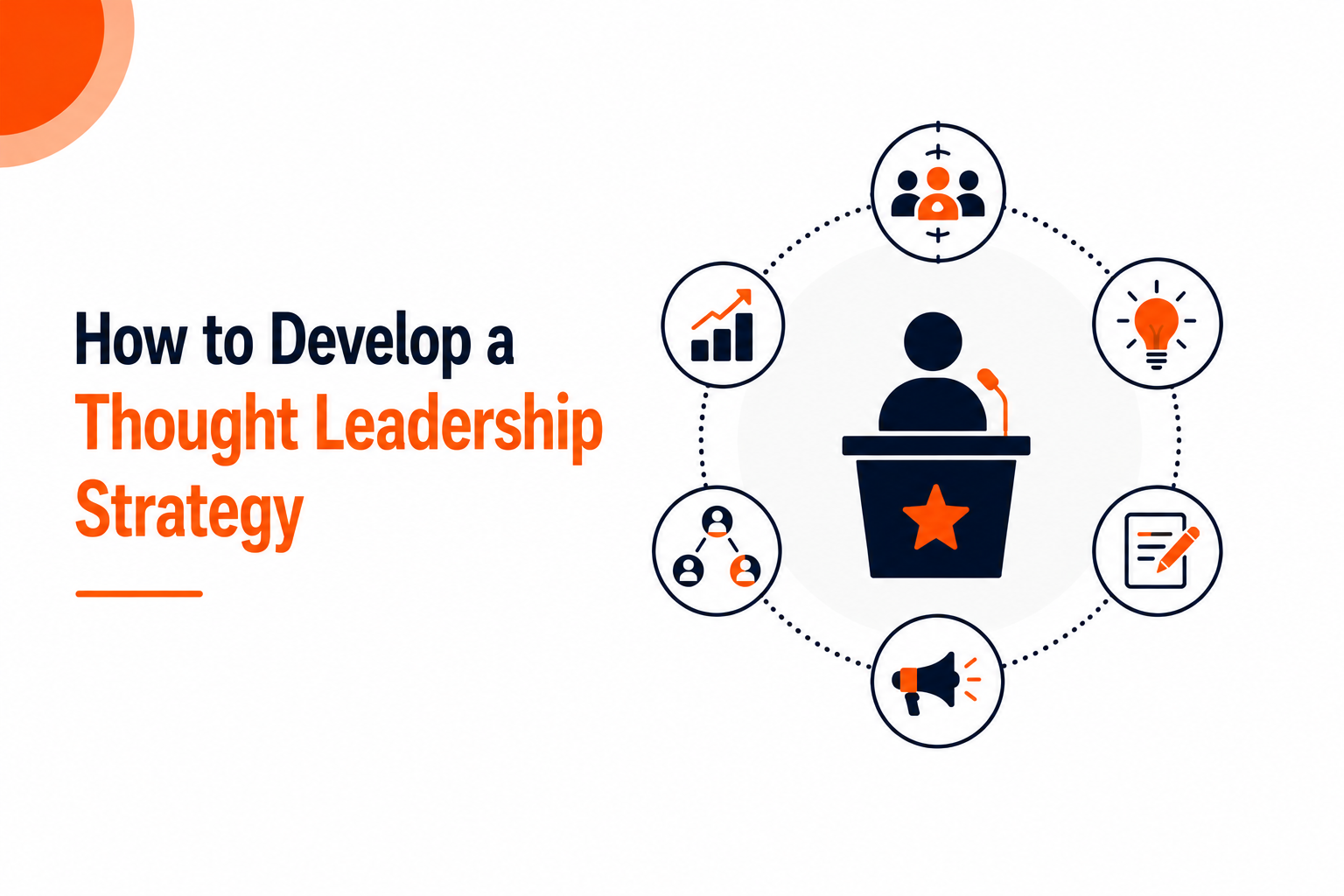
How to Develop a Thought Leadership Strategy
Building a credible thought leadership strategy is one of the most effective long-term investments a company or individual professional can make in their reputation and business growth. Thought leadership is not about broadcasting opinions; it is about consistently delivering insight that other professionals in your industry find genuinely useful, forward-thinking, and worth sharing.
Companies that execute this well become the first names buyers think of when a problem arises that sits squarely in that company’s area of expertise. The result is shorter sales cycles, deeper referral networks, better talent attraction, and an organic content presence that compounds in authority over time. This article covers every stage of developing a thought leadership strategy that produces those outcomes, from foundational definition to platform-specific execution.
What Is a Thought Leadership Strategy
A thought leadership strategy is a deliberate, structured plan for positioning a company or individual as a trusted, authoritative voice within a specific industry or subject area. The word “strategy” is important here because thought leadership without a plan produces inconsistent output that fails to build a recognizable point of view over time.
A well-built thought leadership strategy answers four foundational questions:
- Who is the thought leader? This could be a company as a whole, a founding executive, a subject matter expert, or a combination of individuals whose collective expertise anchors the brand’s authority.
- What specific area of expertise does this person or company own? Broad claims of expertise across too many topics dilute authority. The most effective thought leaders are known for a defined, specific domain.
- Who is the target audience? Thought leadership content must be calibrated to the people it is meant to influence, their level of sophistication, their specific problems, and the platforms where they consume content.
- What is the goal? Goals vary across organizations. Some use thought leadership to drive inbound leads, others to support enterprise sales conversations, others to attract investors or media attention. The goal shapes the format, platform, and tone of everything produced.
How to Create a Thought Leadership Strategy
Creating a thought leadership strategy involves moving from the answers to those foundational questions into a structured, repeatable content and distribution system.
Step 1: Audit Existing Expertise and Content
Before producing anything new, take stock of what already exists. Past presentations, internal reports, client case studies, and subject matter expertise held by team members are all raw material for thought leadership content. Identifying what is already available prevents the common mistake of starting from scratch when a substantial foundation already exists.
Step 2: Define Your Point of View
A point of view is not a summary of industry consensus. It is a specific, defensible perspective on how a problem should be solved, where an industry is heading, or what most practitioners are getting wrong. A well defined point of view creates conversation, attracts an audience that agrees, and earns attention from people who disagree but find the argument worth engaging with.
Step 3: Map Content to Audience and Funnel Stage
Thought leadership content serves different purposes at different stages of a buyer’s journey. Educational content builds broad awareness. Opinion pieces and trend analysis attract mid-funnel prospects evaluating vendors. In-depth case studies and original research speak directly to buyers in active evaluation mode. A complete strategy maps content formats and topics to each of these stages.
Step 4: Build a Publishing Calendar
Consistency is what separates thought leadership from occasional content marketing. A publishing calendar that commits to specific formats, topics, and frequencies, and that assigns clear ownership for each piece, is what makes sustained output operationally possible.
Step 5: Plan for Distribution
Publishing content without a distribution plan produces minimal results regardless of quality. Every piece of thought leadership content needs a defined set of distribution channels, including owned channels like email newsletters and social media, earned channels like media coverage and guest publications, and paid amplification where the budget allows.

Content Strategy for Thought Leadership
The content itself is where a thought leadership strategy either earns attention or fades into background noise. These are the formats and principles that produce the most durable impact.
Original Research and Data
Nothing builds thought leadership authority faster than proprietary data. Surveys, industry benchmarks, and original research give a brand something no competitor can replicate or refute, and they generate backlinks, media coverage, and social sharing that purely opinion-based content rarely attracts.
Long-Form Articles and Guides
In-depth, well-researched articles that address a problem comprehensively demonstrate the kind of expertise that earns trust. These pieces should not merely aggregate existing information; they should add a layer of analysis, a specific recommendation, or a framework that readers cannot find elsewhere.
Podcast Appearances and Interviews
Being interviewed on respected industry podcasts places a thought leader’s perspective in front of an established, engaged audience that already trusts the host. A consistent podcast appearance strategy, targeting shows whose audiences align with the thought leader’s target buyer, builds name recognition at a scale that owned channels alone rarely produce.
Speaking Engagements
Conference presentations and panel appearances provide live proof of expertise that written content cannot replicate. Video recordings of these appearances extend their reach well beyond the room and provide repurposing material for social media, blog posts, and email content.
Case Studies and Client Stories
Real-world results, told with specificity and honesty about both successes and challenges, demonstrate applied expertise in a way that pure opinion never can. Case studies that name specific outcomes, strategies used, and lessons learned are among the most persuasive pieces a B2B thought leader can produce.
LinkedIn Thought Leadership Strategy
LinkedIn is the most powerful platform for B2B thought leadership and deserves a platform-specific strategy, not a repurposing of content designed for other channels.
Profile Optimization as a Foundation
A thought leader’s LinkedIn profile should function as a landing page, not a resume. The headline should communicate a specific point of view, not just a job title. The About section should tell a story about why this person’s perspective on their subject area is worth following.
Content Formats That Perform on LinkedIn
- Text-only posts with a specific insight or contrarian take. These consistently outperform link posts in organic reach because LinkedIn’s algorithm favors content that keeps users on the platform.
- Carousels and document posts. Slide-style documents that walk through a framework, a research finding, or a step-by-step process generate high save rates and extended reach.
- Short-form video. Native video uploaded directly to LinkedIn performs better than links to external video platforms. Two to three minute videos that deliver a single, well-framed insight perform particularly well.
- Newsletter articles. LinkedIn’s native newsletter feature builds a subscriber base that receives notifications when new content is published, creating a direct distribution channel independent of the algorithm.
Engagement as a Strategy
Publishing content is only half of a LinkedIn thought leadership strategy. Commenting substantively on posts from other respected voices in the industry, sharing perspectives in relevant conversations, and responding to every comment on one’s own posts all signal active participation that LinkedIn’s algorithm rewards with expanded reach.
Consistency Over Volume
Three high-quality LinkedIn posts per week produced consistently over six months will outperform daily posting that burns out after four weeks. Building a sustainable publishing cadence is more important than maximizing frequency.
Crescita Solutions: Thought Leadership Content Strategy Agency
Crescita Solutions is a full service web design, development, and SEO company that builds thought leadership content strategies for businesses across industries and geographies. For companies that understand the long-term value of being the most trusted voice in their market, Crescita provides the strategic framework and content production capability to make that vision operationally real.
The Crescita approach to thought leadership strategy includes:
- Audience and expertise mapping to identify the specific subject areas where a company or individual has the depth to sustain a credible, distinctive point of view over time.
- Content strategy development that maps formats, topics, and publishing cadences to business goals and buyer journey stages.
- Long-form content production built around original insight, proprietary framing, and the kind of analytical depth that earns attention from sophisticated B2B audiences.
- LinkedIn strategy and content creation tailored to the platform’s algorithm, audience expectations, and the specific voice of the thought leader being positioned.
- SEO integration ensuring that thought leadership content performs in organic search as well as on social platforms, building compounding visibility across every channel a buyer might use during their research process.
- Distribution planning that extends the reach of every piece of content through owned, earned, and paid channels in a coordinated way.
Thought leadership is a long-term investment, and the companies that commit to it with the right strategy and consistent execution build a competitive advantage that paid advertising cannot buy. Crescita Solutions provides the expertise to develop that strategy and the production capability to sustain it, positioning clients as the authoritative voices their buyers turn to first.