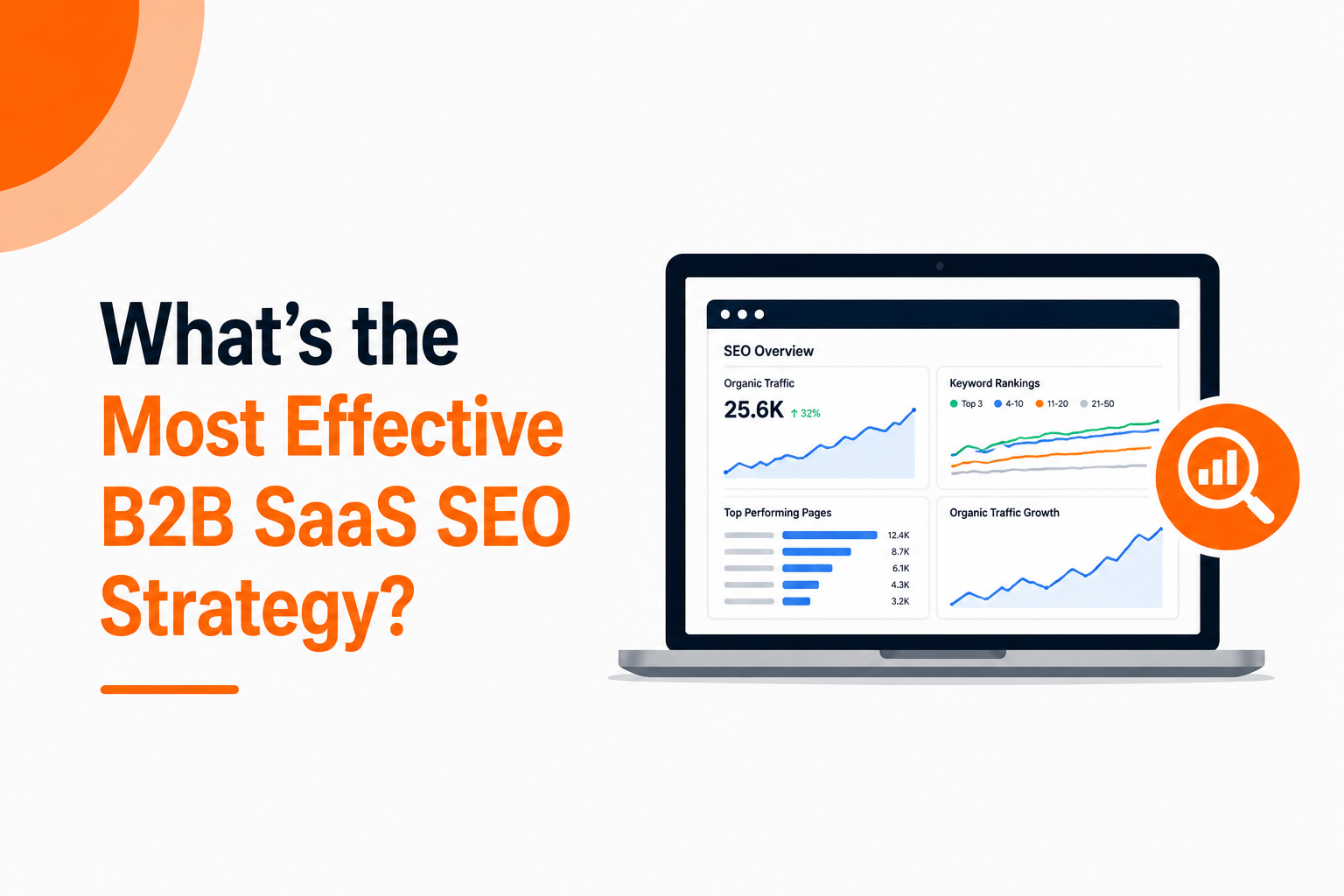
What’s the Most Effective B2B SaaS SEO Strategy?
Building a winning B2B SaaS SEO strategy demands a fundamentally different mindset from consumer-facing SEO. The buyers are more sophisticated, the sales cycles are longer, the decision-making involves multiple stakeholders, and the content must satisfy both the technical evaluator and the executive signing the check. SaaS companies operating in B2B markets are competing for visibility among buyers who spend weeks or months researching solutions before ever filling out a demo request form.
Organic search is where that research begins, and the companies that dominate those early-stage search moments are the ones that build pipeline consistently, predictably, and at a fraction of the cost of paid acquisition. A well-constructed B2B SaaS SEO strategy does not just generate traffic; it positions a company as the most credible answer to the problems its ideal customers are actively searching to solve.
SEO Strategy for B2B Business
B2B SEO strategy shares some surface-level mechanics with B2C SEO, but the underlying logic is entirely different. The goal is not volume for its own sake; it is qualified visibility in front of the specific people who have budget, authority, and a need for what the software solves.
Several foundational principles separate an effective B2B SEO strategy from a generic one:
The Buyer Committee
B2B software purchases rarely come down to one person. An IT director, a procurement officer, a department head, and sometimes a C-suite executive are all involved. A smart SEO strategy accounts for this by creating content that speaks to each of these personas. The technical evaluator needs feature-level depth. The executive needs ROI framing. A strategy that only targets one of these misses the others entirely.
Full-Funnel Keyword Coverage
The most common mistake in B2B SaaS SEO is focusing exclusively on bottom-of-funnel, high-intent terms. Those are valuable, but they are also the most competitive. A full-funnel approach includes:
- Top-of-funnel content targeting problem-aware searches like “how to reduce churn in SaaS”
- Middle-of-funnel content targeting solution-aware searches like “best customer success software”
- Bottom-of-funnel content targeting product-aware searches like “[brand name] vs [competitor]”
Each stage serves a different purpose, and together they build a content ecosystem that intercepts buyers at every point in their journey.
Domain Authority as a Long-Term Asset
In competitive SaaS categories, domain authority is the foundation everything else is built on. Link building, digital PR, and thought leadership content published on external platforms all feed into this. Companies that invest in authority early find that new content ranks faster and holds positions more durably.
SEO Keyword Strategy for B2B Companies
Keyword strategy in B2B SaaS is less about search volume and more about search intent alignment. A term with 200 monthly searches that attracts VP-level buyers is worth far more than a term with 20,000 searches that attracts the wrong audience entirely.
A productive B2B keyword strategy involves several distinct layers:
Job-to-Be-Done Keyword Research
The most useful frame for B2B keyword research is asking what job a buyer is trying to get done when they search. Someone searching “automate invoice reconciliation” is not browsing; they have a specific operational problem they need solved. Content built around job-to-be-done searches attracts buyers in active problem-solving mode, which is exactly where SaaS companies want to intercept them.
Competitor and Alternative Keywords
Terms structured as “[competitor] alternative” or “best [category] software” represent some of the highest-converting organic traffic available to SaaS companies. Buyers using these terms have already decided they need a solution; they are evaluating options. A well-optimized comparison or alternative page can capture a significant share of this traffic.
Long-Tail Specificity
In B2B SaaS, long-tail keywords often convert better than broad terms because they signal a specific context. “Project management software for construction firms” is more valuable for a construction-focused PM tool than “project management software” because the intent match is exact. Building content clusters around specific industries, use cases, and company sizes is one of the most underutilized strategies in this space.
Negative Keyword Awareness
Not a paid search concept alone, understanding which terms attract irrelevant traffic helps focus content investment. A B2B enterprise software company that keeps appearing in searches for free or consumer tools is wasting crawl budget and diluting its topical relevance signals.

How to Use Analytics for B2B SEO Strategy
Analytics transforms SEO from a set of educated guesses into a feedback-driven system. The companies producing the best B2B SEO results are the ones treating data as an ongoing input into every decision.
Google Search Console as a Conversion Signal Map
Search Console shows exactly which queries are driving impressions and clicks to a site. For B2B SaaS companies, this data is a direct window into how buyers are actually describing their problems. Pages with high impressions but low click-through rates signal a mismatch between the meta title and description and the searcher’s expectation, a fixable problem that can unlock significant traffic gains without creating new content.
Engagement Metrics and Content Quality
Tools like GA4 reveal how visitors behave once they arrive. High bounce rates on a product page, short average session durations on a blog post, or low scroll depth on a pillar page all indicate that the content is not meeting the visitor’s expectations. These signals should trigger content audits and rewrites.
Pipeline Attribution
The most advanced B2B SaaS companies connect their SEO analytics to CRM data to understand which organic landing pages are contributing to closed revenue. This level of attribution allows marketing teams to make investment decisions based on what actually generates customers, not just what generates traffic.
Rank Tracking with Segmentation
Tracking keyword rankings is only useful when the data is segmented meaningfully. Grouping tracked keywords by funnel stage, persona, product line, or content type gives a much clearer picture of where the strategy is performing and where gaps exist.
Data-Driven B2B SEO Strategy Implementation
Knowing what to do and building a system that executes it reliably are two different challenges. Data-driven implementation is where strategy meets operational discipline.
Content Prioritization Through Opportunity Scoring
Not every keyword or content idea deserves equal investment. An opportunity scoring model weighs factors like search volume, competition level, buyer intent, and relevance to core product positioning to produce a ranked list of content priorities. This prevents the common trap of producing high volumes of low-impact content.
Programmatic SEO for Scale
SaaS companies serving multiple industries, use cases, or geographies can use programmatic SEO to generate large numbers of targeted landing pages from structured data. An HR software company might build individual pages for “HR software for [industry]” across dozens of verticals. When done with genuine depth and not thin, templated content, this approach can produce enormous reach with manageable production overhead.
Content Refresh Cadence
Published content is not a finished asset. Pages that ranked well two years ago may have slipped due to algorithm updates, new competitors, or changing search intent. A systematic content refresh process, driven by rank tracking and traffic data, recovers lost positions and strengthens the overall content library without requiring the same investment as producing new content from scratch.
Technical SEO as an Ongoing Function
Site speed, crawlability, indexation, Core Web Vitals, and structured data are not one-time fixes. As SaaS products evolve and websites grow, technical issues accumulate. Monthly technical audits catch problems before they compound into ranking losses.
Cross-Functional SEO Integration
The most effective B2B SaaS SEO programs are not siloed in a marketing corner. Product teams surface feature terminology that buyers use. Sales teams report the exact language prospects use to describe their problems. Customer success teams identify post-purchase questions that can become high-ranking FAQ content. When SEO thinking is embedded across functions, the content output becomes far more aligned with actual buyer behavior.
Crescita Solutions: B2B SaaS SEO Partner Built for Growth
Crescita Solutions is a full-service web design, development, and SEO company with a global client base and a sharp focus on building organic growth for businesses operating in competitive digital markets. For B2B SaaS companies, Crescita delivers a strategy that is built from the data up and executed with precision at every layer.
What Crescita brings to B2B SaaS SEO engagements:
- Full technical SEO audits covering site architecture, speed, crawlability, and Core Web Vitals.
- Keyword research and content strategy built around buyer personas and funnel stages.
- On-page optimization for product pages, feature pages, and comparison landing pages.
- Long-form content production written with genuine subject matter depth.
- Link building through credible SaaS, technology, and industry publications.
- Analytics setup and ongoing reporting tied to traffic, rankings, and pipeline contribution.
- Programmatic SEO consulting for companies scaling to high page volumes.
Crescita does not sell packaged SEO programs that ignore the specific nature of a B2B SaaS business model. Every engagement starts with understanding the product, the ideal customer profile, the competitive set, and the growth objectives. From that foundation, a strategy is built that treats organic search as a revenue function, not a surface-level pursuit.