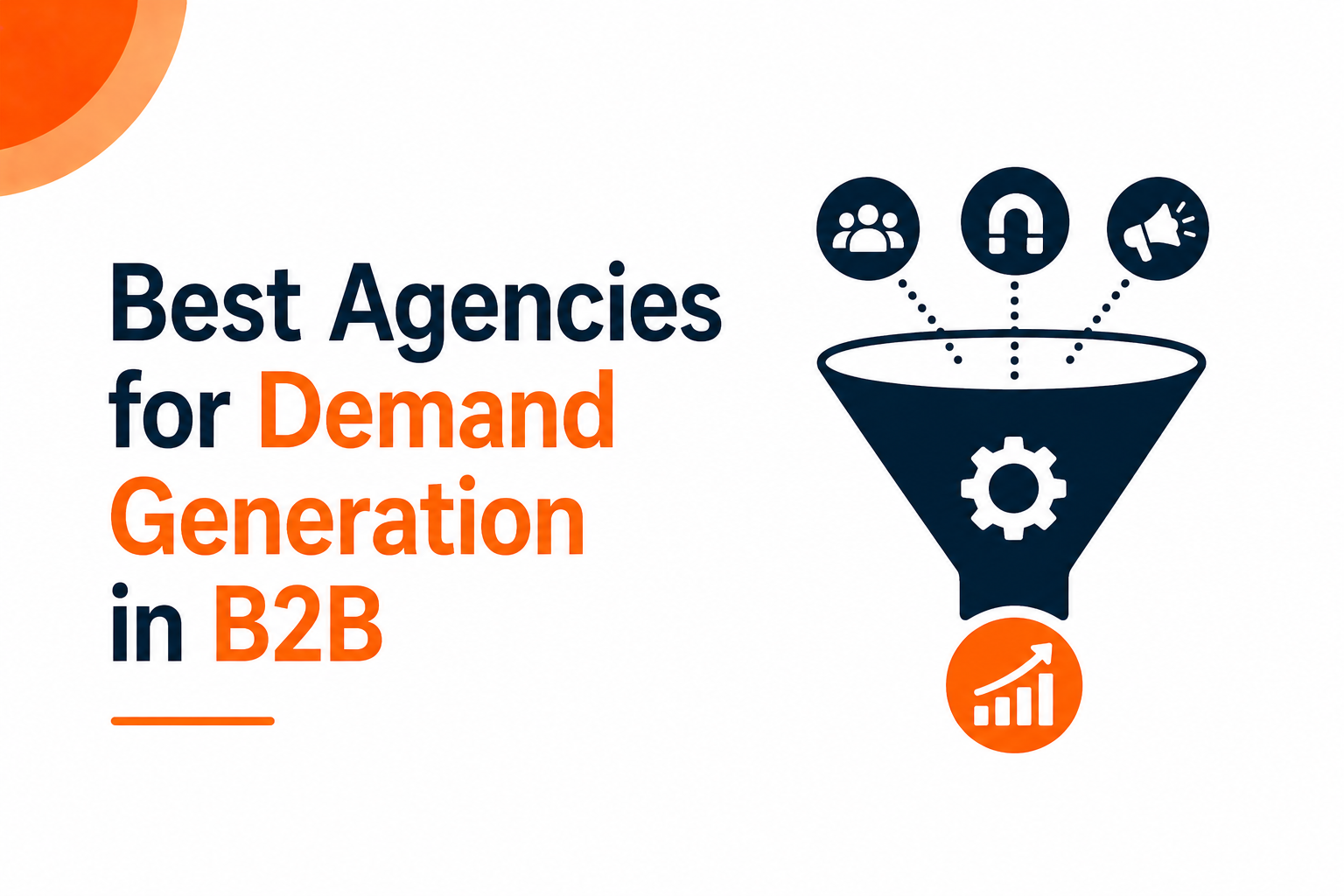
Best Agencies for Demand Generation in B2B
Most B2B companies have a lead generation program. Very few have a demand generation program. The two are not the same thing, and the difference between them is the difference between a marketing function that fills a spreadsheet with contacts and one that builds the commercial conditions under which the right buyers arrive at the sales conversation ready to act.
The best agencies for demand generation in B2B understand this distinction completely and build programs around it. They are not optimizing for impressions, form fills, or MQL counts. They are building awareness, shaping preference, and accelerating pipeline for companies whose sales cycles are long, whose buying committees are complex, and whose revenue targets depend on marketing doing more than generating noise. This article covers what B2B demand generation actually is, what best practices define the programs that work, and what a well-built demand generation strategy looks like in practice.
What Is B2B Demand Generation?
B2B demand generation is the set of marketing activities that create awareness of a problem, build interest in a category of solution, and develop preference for a specific brand before a buyer enters a formal purchasing process. It is upstream of lead generation. It is the work that makes lead generation more efficient by ensuring that the buyers who eventually convert have already been educated, warmed, and partially convinced.
The scope of B2B demand generation is broader than most marketing teams initially expect. It includes:
- Content that reaches buyers before they are actively searching for a solution
- Paid media programs that build brand awareness within a defined target account list
- Thought leadership that positions the company as an authoritative voice in its category
- Community building and event marketing that creates peer-level exposure
- SEO that captures buyers when they begin actively searching for solutions
- Email and nurture programs that move engaged buyers through the consideration process
- Sales enablement content that supports the buying committee through the decision stage
The unifying principle across all of these activities is that they are designed to create and cultivate demand, not just capture it. Demand capture, which is what most lead generation programs do, works only on buyers who are already in the market. Demand creation reaches buyers before they are in the market and builds the awareness and preference that shapes their decision when they eventually do start searching.
For B2B companies with long sales cycles and high average deal values, the return on demand generation compounds over time. Buyers who have been following a brand’s content for months before entering a formal evaluation close faster, negotiate less aggressively, and churn at lower rates than buyers who were captured cold. This is the commercial case for demand generation, and it is one of the strongest in B2B marketing.
B2B Demand Generation Best Practices
The programs that produce real pipeline results share a set of practices that separate them from the programs that generate activity without commercial impact.
Align messaging to the full buying committee
B2B purchases are rarely made by a single person. The average enterprise buying decision involves six to ten stakeholders, each with different priorities, different information needs, and different objections. A demand generation program that only speaks to one job title or one level of seniority is leaving most of the buying committee unaddressed.
Separate demand creation from demand capture
Many companies make the mistake of running their entire marketing budget on demand capture, targeting only buyers who are already in-market with bottom-of-funnel ads and content. This produces short-term leads but does not build the pipeline of future buyers who will enter the market next quarter or next year. A well-structured demand generation program allocates budget to both, with demand creation activities building the future pipeline and demand capture activities converting the buyers who are ready now.
Use intent data to prioritize accounts
Not all target accounts are at the same stage of their buying journey at the same time. Intent data platforms surface signals that indicate which accounts are actively researching solutions in your category right now. Concentrating demand generation resources on high-intent accounts dramatically improves conversion rates and reduces wasted spend on accounts that are not yet in the market.
Build content for every stage of the funnel
The content that creates category awareness is different from the content that accelerates a buyer who is already in evaluation. Top-of-funnel content addresses the problems and challenges your ideal buyers face, without necessarily mentioning your product. Mid-funnel content introduces your category of solution and demonstrates why it addresses those problems. Bottom-of-funnel content makes the specific case for your product: comparisons, case studies, ROI calculators, and detailed technical documentation that removes the final objections.
Measure pipeline influence, not just lead volume
The metric that connects demand generation to revenue is pipeline influence, which tracks the percentage of pipeline opportunities that had meaningful engagement with marketing content before or during the sales process. This metric is a far more accurate indicator of demand generation effectiveness than MQL volume, cost per lead, or click-through rates.
Invest in brand consistently
B2B buyers buy from brands they trust, and trust is built through consistent, high-quality presence over time. Companies that invest in brand-building content, thought leadership, and community engagement build a recognition advantage that compounds with every piece of content published and every industry conversation participated in.

B2B Demand Generation Strategy
A demand generation strategy is not a list of tactics. It is a structured approach to building awareness and pipeline that is built around a defined target market, a clear understanding of the buyer journey, and a set of measurable outcomes tied to revenue.
Here is what a well-built B2B demand generation strategy covers.
Target account definition
The strategy starts with a precise definition of the companies and roles the program is designed to reach. This is the ideal customer profile, defined by industry, company size, geography, technology stack, and any other factors that predict fit and propensity to buy.
Channel selection based on where buyers actually are
Different B2B buyer segments spend time in different places. Enterprise technology buyers read industry publications and engage on LinkedIn. Manufacturing buyers attend trade shows and search for technical specifications. Professional services buyers rely heavily on peer referrals and thought leadership. A demand generation strategy selects channels based on where the target buyers are, not based on what channels are easiest or cheapest to run.
Content architecture that maps to the buying journey
Every piece of content in the strategy should have a defined purpose: creating awareness, building consideration, accelerating evaluation, or supporting the close. Content produced without this mapping tends to cluster at the top of the funnel, where it builds traffic but not pipeline.
Sales and marketing alignment on pipeline definitions
Demand generation strategy fails when marketing and sales define pipeline differently. Before launching a program, align on what constitutes a marketing-qualified account, what handoff criteria trigger sales outreach, and how marketing-influenced pipeline is tracked in the CRM. This alignment prevents the most common source of dysfunction in B2B demand generation programs.
A 90-day sprint structure within a 12-month program
Demand generation produces compounding results over time, but it needs short-term milestones to stay accountable. Structure the 12-month strategy into 90-day sprints with defined deliverables, measurable outcomes, and a review process that adjusts priorities based on what the data shows.
Integration with product and customer success
The best demand generation programs extend beyond the acquisition funnel into retention and expansion. Content that helps existing customers get more value from the product, community programs that connect customers with each other, and case study production that turns customer outcomes into demand generation assets all extend the program’s commercial impact.
Crescita: Best B2B Demand Generation Services
Crescita Solutions builds B2B demand generation programs that are designed around one outcome: revenue. Every program starts with a clear definition of the target market, a mapped buyer journey, and a set of pipeline and revenue metrics that the program is accountable to from day one.
Our team covers the full demand generation stack:
- Target account identification and ideal customer profile development
- Content strategy and production across every stage of the buying journey
- SEO and organic search programs that capture buyers in active evaluation
- Paid media and account-based advertising aligned to target account lists
- Email and nurture programs built around buyer stage and engagement signals
- Sales enablement content that equips sales teams to close the demand marketing creates
- Pipeline reporting that connects marketing activity to revenue outcomes
We work with B2B companies across SaaS, professional services, manufacturing, and technology, and we build programs that reflect the specific buyer dynamics, sales cycle length, and competitive context of each client’s market.
B2B companies that are ready to move from lead generation to demand generation, and want a partner who will be accountable for pipeline and revenue and not just activity metrics, will find the right team here.