
What is Link Audit in SEO?
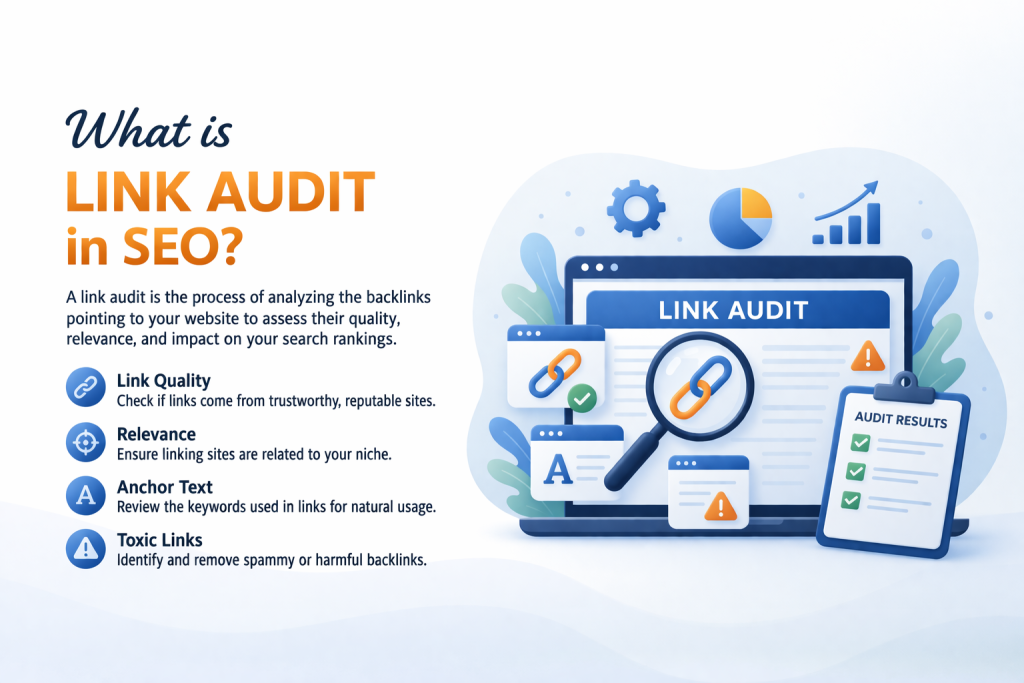
Every link pointing to your website and every link connecting your pages to each other sends a signal to search engines. Those signals accumulate over time, shaping how search engines assess your site’s authority, relevance, and trustworthiness. A link audit in SEO is the process of examining those signals systematically, identifying the ones that are helping your rankings, finding the ones that are hurting them, and mapping the internal link architecture that determines how authority flows across your site.
Without a link audit, you are flying blind on one of the most consequential dimensions of your search performance. You may have toxic backlinks suppressing rankings you should be holding, internal linking gaps leaving high-value pages under-supported, or a backlink profile that looks strong on the surface but carries risk underneath. Crescita Solutions conducts link audits as part of an integrated SEO offer, giving businesses a complete and accurate picture of their link profile and a prioritized plan for improving it.
Importance of Link Audit for SEO
Links remain one of the most significant ranking factors in search. Google’s own documentation and years of industry research consistently confirm that the quality and relevance of the sites linking to yours is a primary signal in how your pages are assessed and ranked. A link audit is important because the link profile your site has accumulated is rarely the link profile you would build if you were starting from scratch with full knowledge of how each link affects your rankings.
Identifying toxic and harmful links
Not all links are beneficial. Links from spammy directories, link farms, private blog networks, and low-quality sites with no topical relevance to your own can suppress your rankings actively. In cases where a site has been the target of negative SEO, harmful links may have been built deliberately to damage its search performance. A link audit identifies these links, assesses their impact, and produces the disavow file needed to neutralize them in Google Search Console.
Understanding your competitive link position
A link audit is not only a diagnostic exercise for your own site. It is a competitive intelligence tool. Comparing your backlink profile against the profiles of the sites ranking above you for your target keywords reveals the link gap you need to close, the types of sites and content that earn links in your market, and the specific link sources your competitors have that you do not.
Protecting ranking equity during site changes
Links pointing to specific URLs on your site carry ranking equity tied to those URLs. When pages are moved, merged, or deleted without correct redirect handling, that equity is lost. A link audit conducted before a site migration, URL restructure, or content consolidation identifies the pages with significant inbound link equity and makes sure those links are redirected correctly so the equity is preserved through the change.
Identifying link building opportunities in your existing profile
A thorough link audit surfaces opportunities alongside problems. Unlinked brand mentions on external sites can be converted into backlinks. Broken links on high-authority sites that previously pointed to your content can be reclaimed with a simple outreach and redirect. Pages on your site that have earned inbound link profiles but are not internally linked to your highest-priority commercial pages are transferring authority inefficiently. All of these opportunities are visible in a detailed link audit and invisible without one.
Maintaining profile health over time
Link profiles change continuously. New links are built or earned. Old links are removed. The sites linking to you change in quality and relevance. A link audit conducted once and never revisited gives you a point-in-time snapshot, not an ongoing understanding of your profile’s health. Regular link audits, conducted annually at a minimum and after any significant SEO event, maintain the accuracy of your understanding and allow you to respond to changes before they affect rankings.
Internal Link Audit Checklist for SEO
Internal links are the connections between pages on your own site. They serve two distinct functions: they help search engines discover and assess the relationship between your pages, and they guide visitors to the content most relevant to their needs. An internal link audit examines both functions systematically.
Crawlability and discovery
- Confirm all important pages are reachable by following links from the homepage within a reasonable number of clicks. Pages buried more than three or four clicks deep from the homepage receive less crawl attention and rank less effectively.
- Identify orphan pages with no internal links pointing to them. Orphan pages are invisible to search engines unless they are included in the XML sitemap, and even then they receive minimal crawl priority.
- Check that the XML sitemap and the internal link structure are consistent. Pages in the sitemap that are not internally linked are being submitted for indexation without the supporting signals that internal links provide.
- Verify that pagination on blog archives, product category pages, and other paginated sections is configured correctly so search engines can follow the full sequence of pages.
Link equity distribution
- Map the internal link counts pointing to each key page. High-priority commercial pages, including service pages, product category pages, and landing pages, should receive more internal links than lower-priority pages.
- Identify pages that are receiving a disproportionately high number of internal links relative to their commercial importance. Excessive internal linking to low-value pages, such as privacy policies, terms and conditions, and thank-you pages, dilutes the link equity available to distribute to pages that actually need it.
- Assess the depth of the internal link hierarchy. A flat site architecture where all pages are closely linked from the homepage distributes authority broadly. A deep hierarchy where important pages are many clicks from the homepage concentrates authority at the top and starves deeper pages of the signals they need.
Anchor text quality
- Review the anchor text used in internal links across the site. Descriptive, keyword-informed anchor text tells search engines what the linked page is about and reinforces its relevance for target queries. Generic anchor text such as “click here,” “read more,” or “learn more” passes link equity without providing topical context.
- Identify instances of anchor text over-optimization, where the same exact-match keyword anchor text is used repeatedly across multiple internal links pointing to the same page. Over-optimized internal anchor text can trigger algorithmic scrutiny in the same way that over-optimized external anchor text does.
- Check for internal links using the site’s domain name as anchor text. These pass equity without topical signal and should be replaced with descriptive anchor text where possible.
Link condition and accuracy
- Identify broken internal links pointing to pages that no longer exist or have been moved without a redirect. Broken internal links waste crawl budget and create a poor user experience.
- Find redirect chains in internal links, where a link points to a URL that redirects to another URL before reaching the destination. Internal links should point directly to the final destination URL, not through redirect chains that add latency and reduce the equity passed.
- Check for internal links pointing to no-indexed pages. Linking to no-indexed pages passes equity to pages that cannot rank and signals to search engines that the site’s internal linking is not well-maintained.
Content and contextual linking
- Assess the internal linking from blog posts, guides, and other content pages to the commercial pages they support. Content pages that rank for informational queries and then fail to link to relevant service or product pages are missing the opportunity to transfer authority and guide interested visitors toward conversion.
- Identify high-authority pages on the site that are not linking to the pages that most need internal link support. A page with a strong inbound external link profile that does not link internally to priority pages is holding authority that could be redistributed to better effect.

Off-Page SEO Audit
An off-page SEO audit examines the external signals that influence your site’s authority and rankings, primarily the backlink profile but also the broader set of signals including brand mentions, social signals, and local citation profiles that contribute to how search engines assess your site’s credibility and relevance.
Backlink profile assessment
The backlink audit begins with a full export of the site’s inbound links from tools including Ahrefs, SEMrush, and Majestic, cross-referenced against Google Search Console’s link report. Using multiple data sources produces a more complete picture of the profile than any single tool provides alone.
The assessment covers:
- Total link volume and the trend over time, identifying periods of rapid link acquisition that may have included low-quality links.
- The distribution of linking domains by authority, relevance, and geographic location.
- The ratio of follow to no-follow links and what it reveals about the nature of the link profile.
- The proportion of links from topically relevant sites versus unrelated sites, which affects how much authority each link actually transfers.
Toxic link identification and disavowal
Toxic link identification involves assessing each linking domain against a set of quality and relevance criteria. Links from sites with no organic traffic, sites with no topical relevance to the audited site, sites that exist primarily to sell links, and sites that have been penalized by Google are candidates for disavowal.
The disavowal process involves compiling the toxic links into a disavow file and submitting it to Google Search Console. Google then discounts those links when assessing the site’s authority. Disavowal is not a guarantee of immediate ranking improvement, but it removes the suppressive effect of toxic links and reduces the risk of a manual penalty for unnatural links.
Link gap analysis
Comparing the audited site’s backlink profile against the profiles of the top-ranking competitors for its target keywords produces a link gap analysis. This identifies the domains linking to multiple competitors but not to the audited site, the content types that earn links in the market, and the specific link sources that are driving competitors’ authority in the most valuable keyword categories.
Local citation audit
For businesses with a local or regional search presence, the off-page audit includes a citation consistency review. The business name, address, and phone number need to match exactly across every directory, listing, and platform where the business appears. Inconsistencies suppress local rankings and undermine the trust signals that Google uses to verify business information.
Crescita Solutions: Best SEO Agency for Link Audits
A link audit is only as valuable as the expertise applied to interpreting the findings and the quality of the action plan that follows. A list of toxic links without a disavowal strategy, an internal link map without prioritization recommendations, or a link gap analysis without a realistic link building plan attached are all exercises that consume time without producing rankings improvements. Crescita Solutions conducts link audits that go from diagnosis to action without that gap.
Every link audit Crescita delivers covers the full scope of the internal and external link profile, with findings presented in an action plan that sequences work by commercial impact. Toxic link disavowal is handled as part of the engagement, not left for the client to figure out from a raw export. Internal link recommendations are specific to the site’s architecture and the commercial priorities of the business. Link gap analysis is translated into a link building strategy grounded in what actually earns links in the specific market the site competes in.
For businesses that have experienced unexplained ranking drops, are preparing for a site migration, or have never had their link profile professionally assessed, a Crescita link audit produces the clarity needed to make informed decisions about where SEO investment will produce the greatest return.